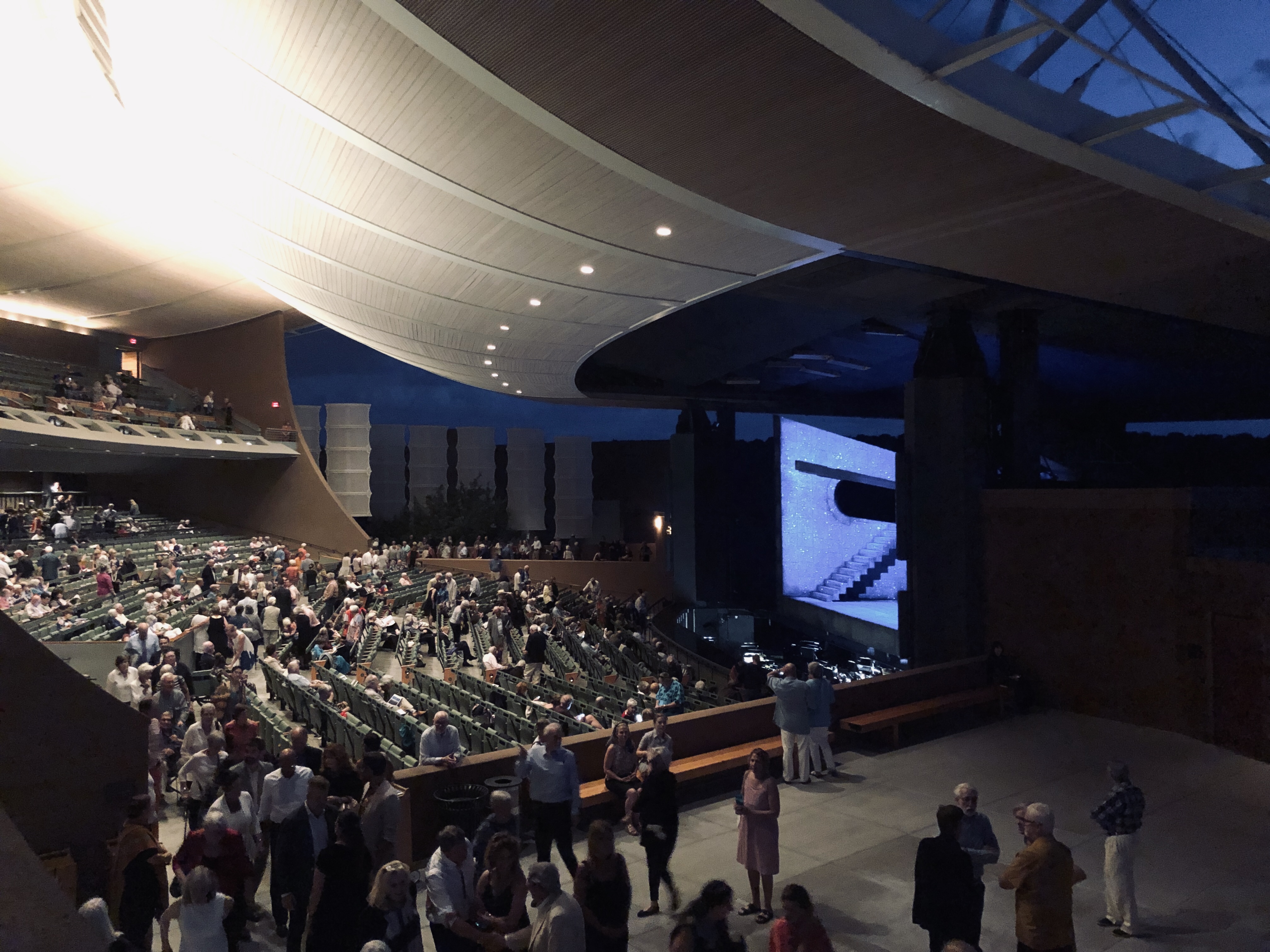
In the company’s latest season, a revelatory production of Mozart’s ‘Così fan tutte’; an appropriately bleak take on Janáček’s ‘Jenůfa’; the world premiere of Poul Ruders’s slight, Brothers Grimm-inspired ‘The Thirteenth Child.’

ByHeidi WalesonAug. 7, 2019 4:30 pm ET
Santa Fe, N.M.
R.B. Schlather’s production of Mozart’s “Così fan tutte” (1790) was the revelation of this Santa Fe Opera season. Mr. Schlather, who has previously specialized in site-specific directing projects, stripped away all period decoration to reveal the mechanics and effects of the cruel trick that is at the heart of opera. Thrillingly executed by the superb cast and orchestra under the incisive leadership of conductor Harry Bicket, this “Così” was modern, disturbing and riveting.
Mr. Schlather solves the conundrum of “Così” by making the manipulator Don Alfonso so embittered by his own disappointments in love that he concocts his elaborate ruse in order to permanently destroy not only the romantic illusions but also the happiness of the four much younger lovers. There’s still comedy, but this malignant intent is established right away when Don Alfonso (Rod Gilfry), dressed in Western gear and a cowboy hat, enters alone during the overture. He is silhouetted menacingly against the New Mexico sunset in the open square at the rear of Paul Tate Depoo III’s empty, sand-colored set, whose walls funnel to that opening. Once all the characters have entered through it, the door slams shut, trapping them in the game. Subsequent exits and entrances are made through large holes in the floor or through side windows that have only darkness behind them, suggestive of the hellish eternity that awaits all lovers.
Aided by Terese Wadden’s witty and perfectly calibrated contemporary costumes, and JAX Messenger’s telling lighting, the detailed directing traces the odyssey of the clueless quartet, who start out as immature frat-boy and cheerleader types, in sporty whites, and are gradually ensnared in messy emotional drama and explicitly choreographed sexual games. All four singers—Ben Bliss (Ferrando), Jarrett Ott (Guglielmo), Amanda Majeski (Fiordiligi) and Emily D’Angelo (Dorabella)—have glorious voices that blend beautifully and are ideal for these roles, making their helplessness doubly upsetting. Directing choices were driven by the music, and each episode happened for a reason: During Mr. Bliss’s exquisite performance of “Un’aura amorosa,” which can be just a pretty tenor aria, the subtle body language of Mr. Gilfry and Tracy Dahl, an irrepressible Despina, told us that they were hearing it as an echo of their own old, now rotted, love affair. And the ensemble finale, usually an unsatisfactory attempt to close the circle of partner-swapping that has preceded it, was instead explosive, cementing the fact that Don Alfonso has succeeded.
In Janáček’s “Jenůfa” (1904), the orchestra, conducted by Johannes Debus, was again outstanding, creating a propulsive dramatic arc with a broad color palette and some standout solo playing. David Alden’s modern-dress production was appropriately bleak—a corrugated metal wall for the mill/factory and mostly drab costumes that suggested Communist-era Eastern Europe (Charles Edwards did the sets, Jon Morrell the costumes, Duane Schuler the lighting). The star of the show was Patricia Racette, an unusually youthful Kostelnička, who drowns her stepdaughter Jenůfa’s out-of-wedlock baby in order to protect her own social standing. In addition to the requisite toughness, Ms. Racette brought complexity and anguish to the role. Laura Wilde was a poignant Jenůfa; in Act II, her portrayal of a new mother’s instinctive terror for her baby was startlingly realistic. Richard Trey Smagur, who is imposingly tall, used the insouciant ease of his bright tenor to make her boyfriend, Števa, seem especially pouty and privileged. Alexander Lewis’s tenor was too light for the mercurial Laca, who loves, wounds and finally marries Jenůfa; as the foreman of the mill, baritone Will Liverman had a more potent sound. The Santa Fe Opera Chorus was excellent, and clearly directed as a cheerful, drunken crowd in Act I and as a menacing mob in Act III. Choreographer Maxine Braham supplied a vigorous folk dance for the opera’s one carefree moment.
Poul Ruders’s “The Thirteenth Child,” in its world premiere, proved disappointingly slight, especially in comparison with his wrenching “The Handmaid’s Tale” (2000), most recently seen in Boston this spring. Becky and David Starobin’s thin libretto, inspired by a Brothers Grimm fairy tale, had stilted language, undeveloped characters and sketchy plotting that vaulted across years, frequently relying on one character to tell others—and the audience—what had happened in the meantime. A king, Hjarne, fears that his twelve sons will overthrow him and decides to kill them first. Spirited away by their mother, Queen Gertrude, they are found eighteen years later by their sister, Lyra, who accidently turns them into ravens. She then has to remain mute for seven years in order to break the spell. Opera demands more emotional nuance than written fairy tales, and the libretto’s skimpiness created some puzzlers: Why, for example, does Lyra immediately cut down the lilies planted around her brothers’ cottage? This bad guest behavior results in their transformation into ravens, but it seems rude and unmotivated, especially since she knows that the lilies are, at the very least, symbols of their homeland.
Mr. Ruders’s score consisted of strung-together set pieces—a funeral chorus, a brief comic ensemble for the brothers, a death scene—which, though sometimes effective, had wildly varying styles that didn’t cohere. Some of the choices, like the angry Hjarne’s startlingly tonal and lyrical aria, and his vocal leaps from sepulchral bass into falsetto, seemed downright odd. As Gertrude, the eloquent mezzo Tamara Mumford made the most persuasive case for her music; with his appealing high tenor, Bille Bruley was touching as the youngest brother, Benjamin. David Leigh’s bass wasn’t powerful enough to convey Hjarne’s fury; soprano Jessica E. Jones was pleasant but understated as Lyra; and bass-baritone Bradley Garvin had little to work with as Hjarne’s villainous cousin, Drokan, who tells the king to fear his sons. Paul Daniel led the somewhat scrappy-sounding orchestra.
Director Darko Tresnjak had mixed success in welding the evening together. Alexander Dodge’s gloomy set had staircases that seemed designed by Escher and Rita Ryack created fairy tale-inspired costumes for the king and queen and went basic for everyone else. The minimalist projection elements—snakes to accompany the villain, forest trees—provided some texture and solved the transformation problem with the shadows of flying ravens. Next season’s world premiere—“M. Butterfly,” with playwright David Henry Hwang and composer Huang Ruo creating an operatic version of Mr. Hwang’s hit 1988 play—promises to be more ambitious.
—Ms. Waleson writes on opera for the Journal and is the author of “Mad Scenes and Exit Arias: The Death of the New York City Opera and the Future of Opera in America” (Metropolitan).