
at the Met.
In Praise of Painting
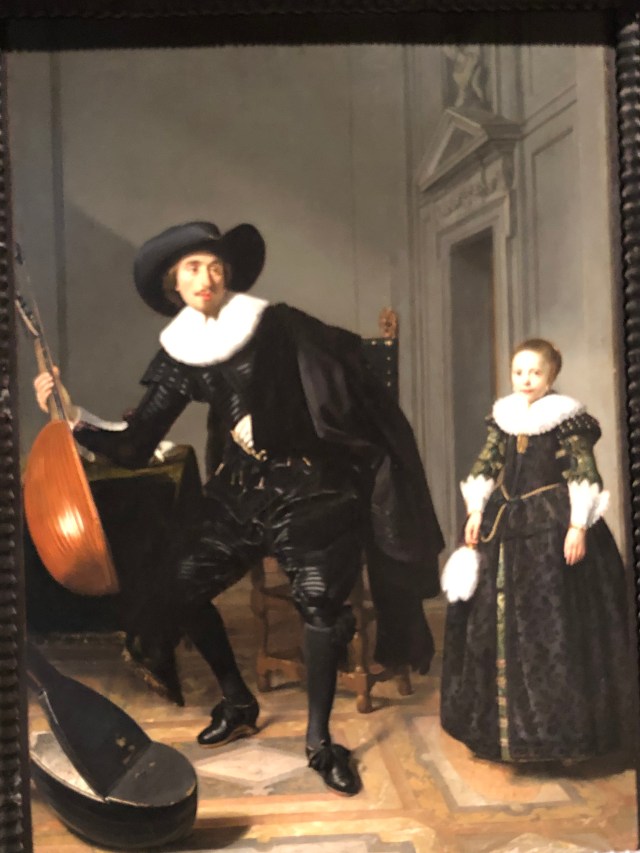
Dutch Masters at the Met
Train with no midnight @ Here. Doubleheader.
Thistree @ Here
Never smile at the brass.
The review in this morning’s paper by Corinna da Fonseca-Wollheim reminds me of story told to me by one of my early mentors, Dick Kapuscinski, Oberlin cello professor and principal cello at the Boston Symphony for decades. Dick related that at a BSO rehearsal with conductor Fritz Reiner, the players were frustrated by his economic but nearly invisible beat. At one point one of the players whispers to himself “Maestro, maestro, the beat!” and Reiner ignored him and continued the rehearsal. A second time and in a conversational tone, the player says, “Maestro, maestro the beat!” and again Reiner ignored him. A third time, the player stands up and screams “Maestro, the beat; it’s too damn small.” Reiner puts, down his baton, stops the rehearsal and smiles slyly, “Small but good,” he replies.
Portraits of Pain at the Prototype Festival
The opera-theater festival’s two big shows, ‘prism’ and ‘4.48 Psychosis,’ portray varieties of mental chaos.

A scene from Ellen Reid’s ‘prism’ at the Prototype Festival Photo: Maria Baranova 0 Comments By Heidi Waleson Jan. 9, 2019 4:50 p.m. ET
New York
The opera-theater pieces of the Prototype Festival tackle unconventional subjects, often in uncomfortable ways, and two big shows of its seventh season are no exception. At La MaMa, Ellen Reid’s gripping “prism” (it had its world premiere in November at the LA Opera) starts out mysteriously. Who are these two women, Bibi (Anna Schubert) and Lumee (Rebecca Jo Loeb), snuggled in bed together in a cozy white room whose door has multiple locks? Bibi can barely stand. Lumee tries to get her to take medicine; she spits it out. They recite a sequence of nonsense words and enact rituals. There’s talk of memory and forgetting; that yellow is safe, but blue, which is outside the door, is not; that Bibi is getting worse, and her bones will soon turn to dust. Is Lumee Bibi’s protector, or something more sinister?
The strangeness of Roxie Perkins’s libretto turns out to be deliberate. This is an internal struggle, a depiction of PTSD following a sexual assault, and the things ricocheting around inside the sufferer’s head probably don’t make sense to anyone else. However, Ms. Reid’s urgent, kaleidoscopic music clearly supplies the turbulent emotional soundtrack of Bibi’s world: the sweet, Copland-like melodies with strings, harp and flute that evoke the safety of forgetting; the horn and percussion that accompany her will to remember and heal; the alluring offstage chorus that tempts her to stand up and open the door. The music gets wilder, with infusions of rock and electronics, in the flashback Act II, which depicts the precipitating event—a sexual assault in a club. Act III is a swifter, grittier replay of Act I, ending with Bibi’s escape.
Ms. Schubert’s pure, naked soprano gave a piercing intensity to Bibi’s pain, and her acting of physical impairment was persuasive; Ms. Loeb’s mezzo, alternately soothing and threatening, made her an intriguing foil. (It’s not clear if Lumee is really Bibi’s mother, who left her child alone to be assaulted and is now overcompensating, or simply a voice in Bibi’s head, but the ambiguity is interesting.) The Choir of Trinity Wall Street and the instrumental ensemble Novus NY, conducted by Julian Wachner, were splendid.
James Darrah’s elaborate production provided this mental world with a vivid, concrete shape. Designer Adam Rigg’s creepy all-white room gave way to 24 hanging disco balls to represent the club, and then to the messy squat of Act III; Pablo Santiago drenched the sets with colored light; Molly Irelan did the costumes, which included a childish baby-doll nightgown for Bibi in Act II. Four dancers, in writhing choreography by assistant director Chris Emile, represented the danger and excitement of the world outside the room of forgetting.

A scene from Philip Venables’s ‘4.48 Psychosis’ Photo: Paula Court
As an experience of psychological disturbance, Philip Venables’s “4.48 Psychosis,” at the Baruch Performing Arts Center, makes “prism” look like a walk in the park. Based on the final play of Sarah Kane, who suffered from mental illness and killed herself at age 28 in 1999, “4.48 Psychosis” is 90 relentless minutes of raw pain and mental chaos.
Six women, headed by soprano Gweneth-Ann Rand, speak and sing as the voices of the protagonist; they are often drowned out by the heavily amplified 14-member orchestra (Contemporaneous, conducted by William Cole), which includes saxophones and an accordion. Mr. Venables varies his techniques, but even the musically calmer moments are full of agony. A Baroque-like lament is overwhelmed by strings that wail like sirens; texts of conversations between the patient and her doctor, projected on the wall of the set, are violently pounded out by two percussionists (at one point, the doctor is represented by a snare drum, at another, a saw). A long list of drugs, with their terrible side effects and ultimate failure to make any difference, becomes a litany, accompanied by a rollicking orchestra, that is almost comic in its grotesqueness. A blast from an organ ushers in a moment of religious contemplation and clarity, soon exploded into a vocal and instrument cacophony so extreme that the only recourse is electroshock therapy. Yet through the noise you hear the patient’s longing, however hopeless, for some connection that will allow her to stay alive.
This Royal Opera House, Covent Garden production, originally staged at the Lyric, Hammersmith in London in 2016, was directed by Ted Huffman.Hannah Clark’s simple set is a shallow white box with three doors, a few chairs and a table (the orchestra is positioned above); D.M. Wood’s stark lighting alternately floods and shadows this bleak world. The six women, all in the same gray sweater, jeans and sneakers, convincingly portray the protagonist’s fragmented mind, whether they are challenging and throttling each other or singing in ensemble. It’s a place where no one could want to live. If 90 minutes is too long, it’s excruciating to imagine what it would be like for years.
—Ms. Waleson writes on opera for the Journal and is the author of “Mad Scenes and Exit Arias: The Death of the New York City Opera and the Future of Opera in America” (Metropolitan).
 AndyManshel.nyc