
With music by Huang Ruo and a libretto by David Henry Hwang, an opera at New York’s Perelman Performing Arts Center about a viciously bullied Army private proved taut and haunting; uptown, Opera Lafayette’s production of Jean-Joseph Mouret’s 1714 work was a skillful, snappy delight.
By: Heidi Waleson
May 14, 2024
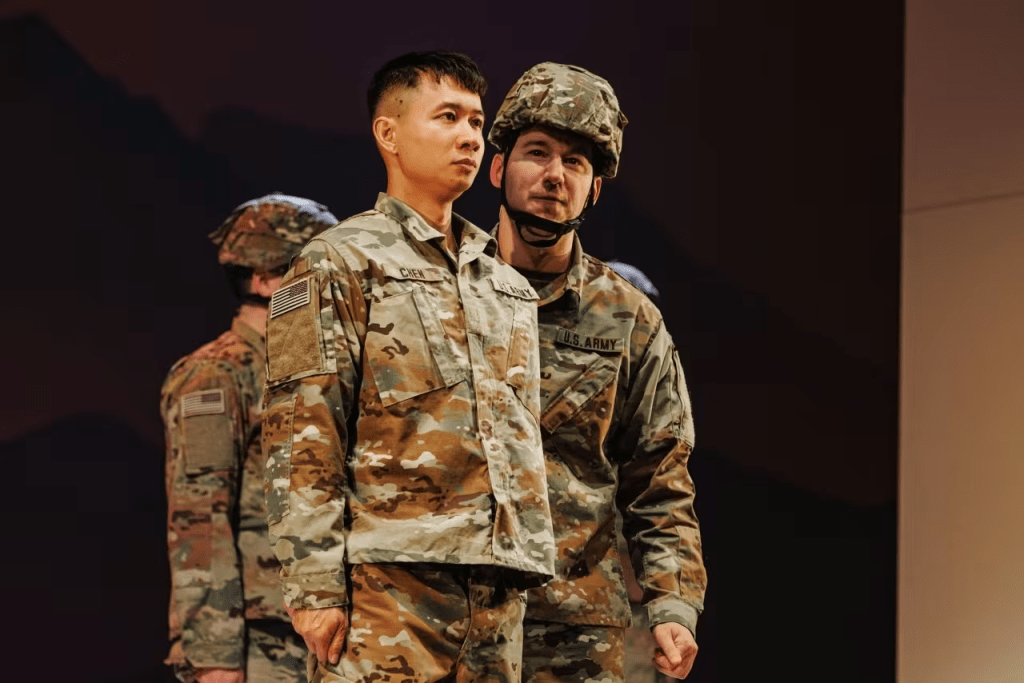
Brian Vu and Alex DeSocio in ‘An American Soldier.’
PHOTO: MARC J. FRANKLIN
New York
Symbols abounded around the New York premiere of Huang Ruo’s opera “An American Soldier” (2018) on Sunday. Its venue, the recently opened Perelman Performing Arts Center, is just blocks from Chinatown, the home of Pvt. Danny Chen, the opera’s real-life protagonist, who took his own life in 2011 after enduring brutal racist hazing in the U.S. Army. Boxy and forbidding, PAC NYC sits across the street from the yawning pits of the 9/11 memorial and catty-corner to the exuberant wings of the Oculus—an impersonal, manufactured crossroads born out of an act of war. Finally, the premiere took place on Mother’s Day, and it is Pvt. Chen’s grieving mother who has this powerful opera’s last word.
Mr. Huang and librettist David Henry Hwang reworked the piece for PAC NYC’s small Zuccotti theater, replacing the large chorus heard in its world premiere at Opera Theatre of Saint Louis with an ensemble of six singers who perform all 18 nonprincipal roles. There is no pit, so the 37-member orchestra was positioned behind the rear scrim, necessitating amplification (David Bullard did the sound design). From a seat in the fourth row, one could hear some natural sound; from the back of the house, the amplification mixing flattened Mr. Huang’s rich orchestral palette and explosive vocal writing.
Still, Chay Yew’s taut, theatrical staging captured the opera’s cruelty and anguish. The well-structured libretto is built around the military trial of Sgt. Aaron Marcum, accused of driving Danny to his death; the story glides seamlessly back and forth from courtroom testimony to flashbacks of Danny’s life before and during his Army service. Danny enlists right out of high school; uninterested in the academically high-achieving, model-minority future expected of Asian teenagers, he longs to find his “team” in the Army. The opera ruthlessly tracks the swift dismantling of that dream. A cheerful, resilient recruit, he takes ethnic slurs in stride during basic training. But once deployed to Afghanistan, he is singled out by Marcum for verbal and physical abuse that intensifies over the course of the second act. In one chilling episode, he is ordered to instruct his platoon—in Chinese—to erect a tent. Just as much as the physical abuse—later, Marcum makes the other soldiers pelt Danny with stones—it makes him believe himself forever an outsider, and kills his hopes.
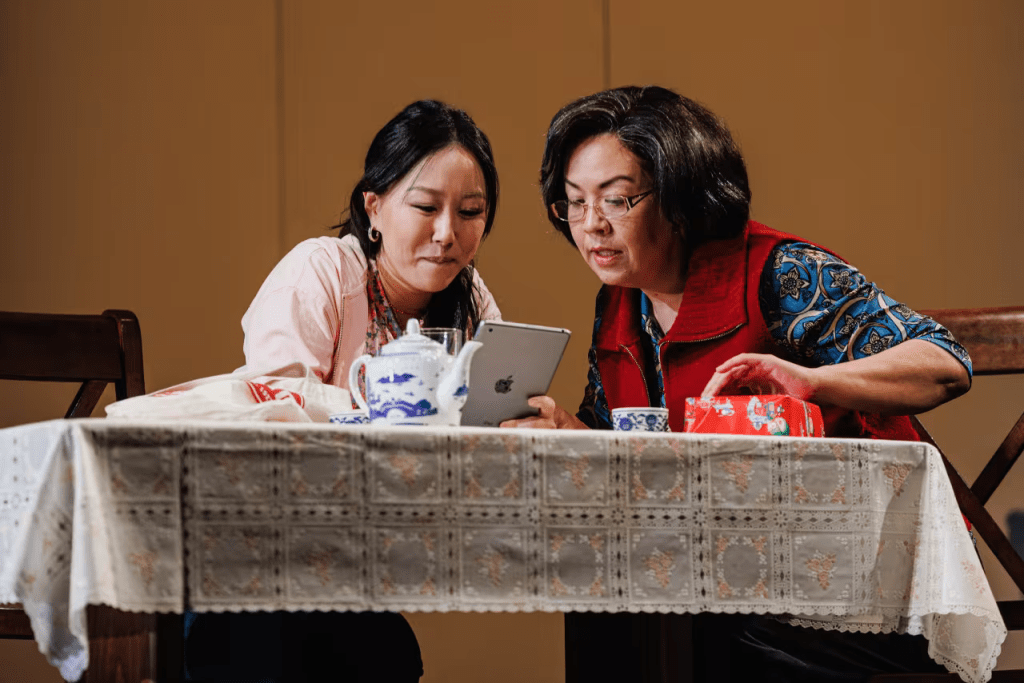
Hannah Cho and Nina Yoshida Nelsen
PHOTO: MARC J. FRANKLIN
Daniel Ostling’s set is an empty, white-sided box; a kitchen table appears for scenes in the Chinatown apartment. Nicholas Hussong’s simple projections on the rear wall suggest locations—the pine trees of the training camp, the mountains of Kandahar; Jeanette Yew’s lighting intensifies the opera’s emotional states, such as cold white bleakness for the courtroom where Danny’s ghost cannot make himself heard and saturated purple for his misery in Afghanistan. A yellow moon accompanies the poignant duet in which Danny and his high-school friend Josephine speak to each other from opposite sides of the world; it expands to fill the entire wall during Mother Chen’s final lullaby. Clean, geometric directing zeroes in on the figures populating the space, whether it’s a line of running soldiers in fatigues (Linda Cho did the costumes) or the intense emotion of a soloist alone onstage.
Tenor Brian Vu was a gripping Danny, seizing on the young man’s determination to be himself, whatever the cost. Nina Yoshida Nelsen’s eloquent mezzo brought out Mother Chen’s toughness, battling the military to get justice for her son. Soprano Hannah Cho relished Josephine’s high-flying vocal lines and exuded warmth in the scenes where she reads Danny’s letters to his mother; Alex DeSocio was appropriately vicious as Marcum.
The six fine ensemble members—Christian Simmons, Ben Brady, Joshua Sanders, James C. Harris, Shelén Hughes and Cierra Byrd—shifted roles with aplomb. Mr. Simmons, with his resonant bass-baritone, stood out as the Military Judge and Pvt. Manny Davis, who testifies about his own experience of Marcum’s racist behavior. Conductor Carolyn Kuan skillfully paced the American Composers Orchestra, winding up the opera’s tension and managing its brief intervals of release. Amplification challenges notwithstanding, we heard—and felt—the military fanfares and ostinatos that limn the anxious progress of Danny’s story and the haunting digeridoo that accompanies his restless ghost.
_______________
Opera Lafayette, a Washington-based company specializing in historical performance, had a winner with Jean-Joseph Mouret’s “Les Fêtes de Thalie” at New York’s El Museo del Barrio on May 7. Hugely popular for decades after its 1714 premiere, this opera-ballet sets out to demonstrate that, in the words of its titular muse of comedy, “One tires quickly of weeping. Does anyone ever tire of laughing?” Muses and gods squabble in the prologue and epilogue that bracket three gossamer-light stories about love. Opera Lafayette’s witty production, directed by Catherine Turocy, with its skillful integration of dance, kept the emphasis on fun, as did the splendid conductor, Christophe Rousset, and the small but snappy period-instrument orchestra; the elegant performing edition was created by harpsichordist Korneel Bernolet.
The game cast of nine singers and eight dancers took multiple roles. Some notable performances included soprano Angel Azzarra aptly over-emoting as the muse of tragedy in the prologue; tenor Scott Brunscheen and baritone John Taylor Ward vying for the hand of a widow in the second vignette, “La Veuve Coquette” (she opts to remain single); and soprano Pascale Beaudin in the roles of the widow, a scorned wife in the third vignette, “La Femme,” and Terpsichore, muse of dance, in the epilogue. Marie Anne Chiment’s gleeful era-mixing costumes helped set the tone. Similarly, each vignette had its own choreographer and style, the most delightful and surprising of which was the Indian wedding staged as an entertainment in the middle of “La Veuve Coquette.” Choreographed by Anuradha Nehru and Pragnya Thamire in Kuchipudi, a classic Indian style, its elegant shapes and sprightly rhythms fit the 18th-century music perfectly.
Ms. Waleson writes on opera for the Journal and is the author of “Mad Scenes and Exit Arias: The Death of the New York City Opera and the Future of Opera in America” (Metropolitan).

 AndyManshel.nyc
How does Vu sound as a tenor? Any high notes? He was a very light baritone….
Sent from my iPhone
<
div dir=”ltr”>
<
blockquote type=”cite”>
LikeLike