
SFO. Opera Managers’ Dinner.
Cosi Fan Tutte
SFO.
‘Das Wunder der Heliane’ Review: Love, Sex and Death
Bard Summerscape stages a production of the obscure, mystical 1927 work by film composer Erich Wolfgang Korngold.

ByHeidi WalesonJuly 30, 2019 4:06 pm ET
Annandale-on-Hudson, N.Y.
Each summer, as part of its one-composer focus, Bard Summerscape exhumes an opera from the repertory graveyard. The Austrian-born Erich Wolfgang Korngold (1897-1957), the subject of this year’s examination, is best known in the U.S. for his movie scores, whose symphonic lyricism swept Hollywood (he resettled there in the 1930s, after the Nazis invaded Austria), and for his crowd-pleasing Violin Concerto, given its premiere by Jascha Heifetz in 1947.
Korngold was a major star in Europe before he scored films like “The Adventures of Robin Hood.” A child prodigy, he attracted attention with a ballet at age 11, and his opera “Die tote Stadt” (1920) was an enormous hit, receiving multiple productions after its premiere in Germany. Bard will present “Die tote Stadt” in concert on Aug. 18, but its fully staged opera production, which opened on Friday, is the truly obscure “Das Wunder der Heliane” (“The Miracle of Heliane,” 1927).
With its weird, mystical story, “Heliane” was out of step with Weimar-era operatic fashion, since audiences were more interested in pieces with contemporary themes. The Bard production, directed by Christian Räth, tried to play down the opera’s heavy-handed, fairy-tale symbolism and religious aura in favor of the emotional journey of the heroine, with some success. However, “Heliane” still seemed less a buried treasure than an intriguing curiosity, worth hearing for its massive, Technicolor orchestration and the way that Korngold’s distinctive idiom recalls not just Strauss and Wagner, but also the clangorous fortissimos of Bartók and the rhapsodic lines of Puccini.
Hans Müller-Einigen’s libretto is based on a play by Hans Kaltneker. Heliane, the only character with a name, is married to the despotic Ruler of an unhappy country. The Ruler has arrested and condemned to death the charismatic Stranger, who has tried to bring joy to the country’s downtrodden people. Heliane secretly visits the Stranger in prison, and to comfort him on the eve of his execution, she shows him her naked body. Her jealous husband, who has never himself gotten past what he calls her “icy innocence,” has her put on trial for adultery (the penalty is death). When the Stranger kills himself to protect her, she is ordered to prove her purity by raising him from the dead, which, indirectly, she does. The overarching theme is the power of love—the act of accepting her own erotic nature allows Heliane to finish the Stranger’s work and free the people. Unsurprisingly, she has to die for this to happen.
Led by Leon Botstein, the 80-member orchestra—complete with triple and quadruple winds, extra brass, two harps and multiple keyboards, including organ, harmonium and celesta—excelled in big statements. Other than the voluptuous eroticism of the encounter between the Stranger and Heliane, Act I was mostly muscular and noisy. However, the court scene of Act II had the dramatic urgency of Puccini. By Act III, the mystical trial, we were well into the realm of Wagnerian apotheosis, with ecstatic melodies enveloped in opulent harmonies.
The massed forces require powerful singers, and soprano Aušrine Stundyte was consistently impressive as Heliane, able to soar over the orchestra yet still maintain an affecting vulnerability, especially in the purity trial, when she sounded like a woman who wanted her lover back. Bass-baritone Alfred Walker clearly conveyed the vicious cruelty of the Ruler with his clipped, aggressive delivery. The Stranger is a challenging Heldentenor part, and Daniel Brenna acquitted himself with clarion distinction in the first two acts, but sounded weary after his resurrection in the third. As the Messenger, who is also the Ruler’s ex-lover, mezzo Jennifer Feinstein infused her performance with bile; tenor Joseph Demarest had a sweetly lyrical cameo moment as the Young Man, who speaks in defense of Heliane. The capable chorus captured the fickle nature of the crowd.

Designer Esther Bialas created an ingenious, if gloomy-looking, Rubik’s cube of a set—several translucent panels, with stairs behind them, that were rearranged throughout to create the various locations. The best was the courtroom, where the six bald judges, in red robes with flowing sleeves and giant ruffs, arrayed themselves forbiddingly on steep bleachers. Ms. Bialis also came up with a good solution for Heliane’s nakedness: a gauzy, semi-transparent garment that revealed just enough to make the point. However, neither the Stranger’s unflattering orange prison jumpsuit nor his resurrection outfit, which looked like plastic wrap, helped reinforce the character’s seductive appeal. Thomas C. Hase’s lighting also took the story’s dark environment a bit too literally: In Act I, it was sometimes difficult to see what was going on.
Mr. Räth’s directing emphasized the story’s human aspects—the Ruler’s festering anger at his wife, Heliane’s gradual awakening as she discovers that she actually loves the Stranger, and how the power of the state is arrayed against her. Catherine Galasso’s movement direction added texture, contrasting the rigid exercises of the guards with a flowing dream sequence during the radiant Act III prelude: A bevy of women, costumed, like Heliane, in the nakedness garment, danced with her, demonstrating the awakening of her true feelings. (They then put her into a straitjacket for the purity trial to come.) The transcendent music at the end of the opera suggests some kind of supernatural union of the two deceased lovers, but Mr. Räth left the dead Heliane alone on the stage at curtain, her “miracle” having cost her everything. So much for fairy tales.
—Ms. Waleson writes on opera for the Journal and is the author of “Mad Scenes and Exit Arias: The Death of the New York City Opera and the Future of Opera in America” (Metropolitan).
The Thirteenth Child
The Santa Fe Opera 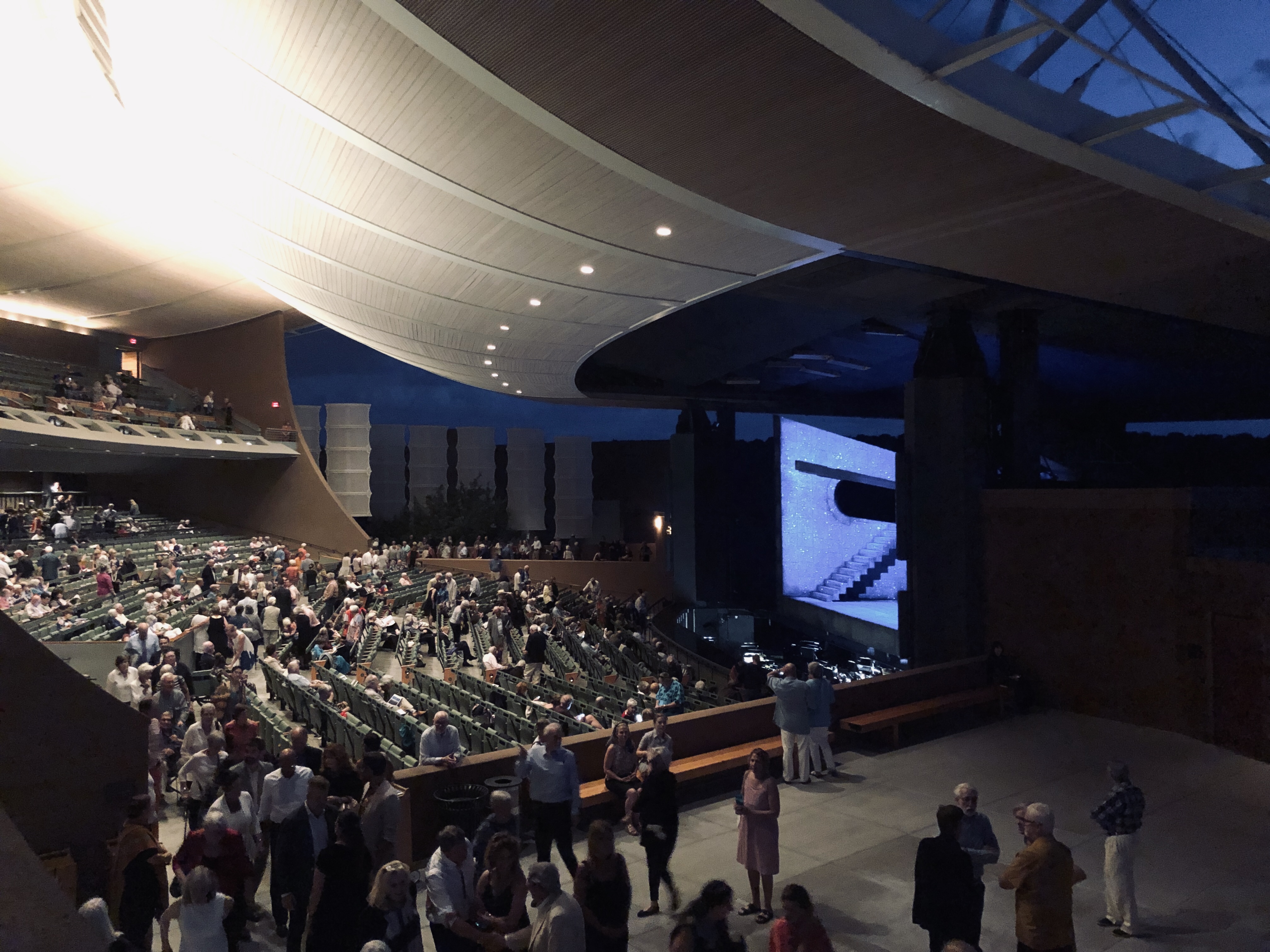
Historic Grace Church
Fr. James’ retirement mass.
‘The Black Clown’ Review: Performing Race
At the Mostly Mozart Festival, Davóne Tines and Michael Schachter’s adaptation of a Langston Hughes poem explores African-American history, identity and musical traditions.

ByHeidi WalesonJuly 26, 2019 2:57 pm ET
New York
‘The Black Clown,” given its New York premiere at the Lynch Theater at John Jay College as part of the Mostly Mozart Festival this week, presents a conundrum. Bass-baritone Davóne Tines and composer Michael Schachter adapted the 1931 poem/dramatic monologue by Langston Hughes, telescoping African-American history—slavery, the Jim Crow era, plus a fervent assertion of the narrator’s humanity—into a 70-minute music theater piece starring Mr. Tines and featuring a splendid ensemble of 12 singer-dancers. However, there’s a built-in tension to the project: The opening line, fiercely spoken and then sung by Mr. Tines, is “You laugh / Because I’m poor and black and funny / Not the same as you.” The narrator then puts on the clown mask (though not literally, in this case) and entertains the festival’s mostly white audience. The performance, therefore, is part of the mask, a representation of blackness designed to amuse, as opposed to authentic blackness.
This disturbing element dominates the evening, since the energy and sheer talent of the show are irresistible. The music, accompanied by a brassy dance band led by Jaret Landon, and drawing on blues, soul, jazz, gospel and other historically African-American genres, is vigorous and catchy; the dancing, choreographed by Chanel DaSilva, explodes with vitality. Even Mr. Tines, with his opulent voice, charismatic presence, and ability to move, if not quite dance, was sometimes upstaged by the enormous energy on display.
The work of director Zack Winokur also seduced, snugly dovetailing the episodes with their shifting moods. “Strike Up the Music,” a frenetic dance number that evoked Harlem clubs and speakeasies, complete with a Billie Holiday-style jazz singer, suddenly took on a heavy, plodding beat as it morphed into “Three Hundred Years.” Depicting the labor and dehumanization of slavery in a work song, it was acted by performers visible only as shadows behind a screen.
Later, the ensemble exploded into “Freedom!,” a long, exuberant sequence that included Abe Lincoln on stilts, a kick line, and a dance that used a noose as a jump rope. The promise of Emancipation was quickly dashed, however: With the line “No land, no house, no job / Black—in a white world / Where cold winds blow,” the lighting (designed by John Torres) went dim. The spiritual “Sometimes I Feel Like a Motherless Child” was eloquently staged as a New Orleans jazz funeral procession, which made its way out into the audience. (Hughes included stage directions, titled “The Mood,” with his monologue, and the creators interpolated arrangements of the two spirituals he mentions into the show.) It sparked a standing ovation, and was indeed seductively powerful, but…applauding a funeral? Again, this was blackness presented as entertainment.
Mr. Tines took the lead in the next sections, depicting first the humiliation of being “Worker and clown…for the ‘civilized’ race” and then the declaration, “But no! Not forever / Like this will I be.” He became a preacher, leading a call-and-response sermon that morphed into “Say to All Foemen,” an ebullient, celebratory gospel church service. The ensemble abandoned its 1930s-chic outfits in favor of contemporary clothes. (Carlos Soto designed the sets and costumes.) “Tear off the garments that make me a clown” is the telling line in this concluding sequence. With it, the show left its midcentury performance aesthetic behind and declared itself a part of the modern world. It also reclaimed those musical traditions for the people who built them, and welcomed the audience as sharers rather than consumers.
Ms. Waleson writes on opera for the Journal and is the author of “Mad Scenes and Exit Arias: The Death of the New York City Opera and the Future of Opera in America” (Metropolitan).
Blind Injustice’ Review: Stories of the Innocent
A new work at the Cincinnati Opera offers a powerful critique of the criminal justice system by focusing on the lives of six people who were wrongly convicted.

ByHeidi WalesonJuly 26, 2019 3:30 pm ET
Cincinnati
‘Blind Injustice,” given its world premiere by the Cincinnati Opera on Monday, started out as a community partnership project for the opera company and became a powerful piece of music theater. A collaboration with the Young Professionals Choral Collective (YPCC) and the Ohio Innocence Project (OIP), the opera, based on the 2017 book by Mark Godsey, the co-founder of OIP, indicts the criminal justice system through the stories of six people who were wrongly convicted, incarcerated—one of them served nearly four decades— and finally exonerated through OIP’s work. Yet this is no mere piece of agitprop, thanks to David Cote’s skillful libretto and Scott Davenport Richards’s tuneful, jazz-inflected score.
The action of the 80-minute opera is framed by lawyers—the aggressive Prosecutor (baritone Joseph Lattanzi) and the more nuanced Defense Attorney (tenor Samuel Levine)—who also reflect younger and older versions of Mr. Godsey, who was a prosecutor in New York before he took up innocence work in Ohio. But the exonerated characters are the heart of the piece, and their voices and stories are vivid and immediate. Mr. Cote wove verbatim material from interviews with the real exonerated people into a seamless, hard-hitting and affecting narrative that deftly explores the deeper issues behind bad convictions. Mr. Richards’s score is equally adroit: It employs a variety of musical idioms, yet always feels unified, and the masterly sections for the four-member Ensemble (who also play secondary characters) and the 24-voice chorus each tell a lot in a short time.
Thus, we get the poignant Nancy Smith (mezzo Maria Miller) in a wistful little aria about her much-loved job as a Head Start bus driver, contrasted with a swirling chorus number in which mothers coach their children in concocting increasingly baroque sexual-abuse allegations against her. Teenagers Laurese Glover (tenor Terrence Chin-Loy), Derrick Wheatt (baritone Sankara Harouna) and Eugene Johnson (bass-baritone Miles Wilson-Toliver) witness a murder in a jaunty, fast-paced scene in which hanging out turns into horror; then the Ensemble members, backed by Minimalist ostinatos from the 12-member orchestra, become scientists who sardonically declare, “It’s the Wonder of Forensics! / Gets ’em every time!” (The East Cleveland 3, as they were known, were convicted in part thanks to dubious physical evidence.) Clarence Elkins (tenor Thomas J. Capobianco), convicted of the murder of his mother-in-law on a flimsy identification, is terrified in prison, as the chorus hisses, “Fresh fish!…Clarence, boy, you better not sleep.”
The uniformly excellent cast also included baritone Eric Shane as Rickey Jackson, who served nearly four decades for murder. Soprano Victoria Okafor as Alesha, the OIP law student who searches for “cracks in the case” in soaring, operatic lines; mezzo Deborah Nansteel as Derrick’s mother, who longs to “break this evil prison down”; baritone Morgan Smith as a scary Earl Mann, the real killer of Clarence’s mother-in-law; and baritone Joseph Parrish as Mann’s cellmate constituted the powerful Ensemble. Conductor John Morris Russell segued easily among musical genres (which also included rap and gospel) as did the small orchestra, centered on a propulsive jazz combo of drum kit, percussion, bass and piano but capable of lyricism and sweep. The excellent chorus included singers from the YPCC along with members of the opera company chorus.
Director and dramaturge Robin Guarino staged the piece on a runway between two banks of spectators in the intimate Wilks Studio at Music Hall. Aided by production designer Andromache Chalfant and lighting designer Thomas C. Hase, she used just one large table that got pushed around, a few chairs, spot-on costumes, and the expressive physicality of the singers to limn the shifting time frames, locations and—most of all—emotional temperatures of the opera.
Ms. Waleson writes on opera for the Journal and is the author of “Mad Scenes and Exit Arias: The Death of the New York City Opera and the Future of Opera in America” (Metropolitan).
The Black Clown
Mostly Mozart.
‘La Straniera’ and ‘La Gazza Ladra’ Reviews: New Corners of the Canon

With period instruments and an unusual orchestral setup, Teatro Nuovo’s productions of two obscure operas by Bellini and Rossini offer a taste of what once made these works so wildly successful.
ByHeidi WalesonJuly 19, 2019 4:08 pm ET
New York
Teatro Nuovo, founded by conductor Will Crutchfield to apply historical performance practice to early 19th-century operas, brought Vincenzo Bellini’s “La Straniera” and Gioachino Rossini’s “La Gazza Ladra” to Jazz at Lincoln Center’s Rose Theater this week. Historical practice has been critical in restoring pre-1800 operas, like those of Handel and Monteverdi, to the performed repertoire, but Mr. Crutchfield is tackling a more familiar period: Bellini, Rossini, and Gaetano Donizetti are firmly ensconced in the canon. With these two fairly obscure operas, Teatro Nuovo opened fascinating corners of repertoire as well as interpretive possibilities.
As was the case last year, in Teatro Nuovo’s first season, the biggest revelation was the superb orchestra. Its period winds, gut strings, and natural horns create a more transparent, subtly colored sound than modern instruments do. It also has an unusual leadership structure and configuration. The concertmaster, Jakob Lehmann, led from a chair at the center; Mr. Crutchfield (“Straniera”) and Rachelle Jonck (“Gazza Ladra”) cued the singers from the fortepiano. Some of the violinists sat facing the stage, the others faced them; the violas, cellos and basses were divided antiphonally, With half of each section on either side of the orchestra, facing each other; the oboes, bassoons and horns sat facing the flutes and clarinets. The players could thus watch and listen to each other rather than being glued to the conductor, and with the orchestra pit raised to audience level they could also see the singers on the stage. The result was an unusually flexible sense of pacing, with the orchestra playing with the same bel canto freedom as the singers. It was remarkably different from conventional performances of these operas, when the orchestra can sound like a background oompah band.
This flexibility was crucial in “La Gazza Ladra” (“The Thieving Magpie,” 1817), where Rossini balances comedy and serious matters with an assured sense of structure and constant melodic invention. The piece starts out buoyant, with its famous jaunty overture and festive opening scene, but quickly turns dark when a servant girl, Ninetta, is accused of stealing silver from her employer and condemned to death. Everything is against her: She has refused the advances of the powerful and lecherous Podestà (Mayor), and to protect her father, who is on the run from a death sentence himself, she doesn’t defend herself from the charge of theft. Rossini sends some musical signals that everything will work out—for example, the carefree main theme of the overture returns when the Podestà doubles down on the accusation. However, the subsequent lengthy scenes of the trial and the march to the scaffold, their ensembles built as skillfully as the composer’s famous comic finales, suggest that maybe it won’t. Only in the last 10 minutes, after three hours of music, does rescue arrive in the nick of time: The magpie did it.
The women in the cast took the honors. Soprano Alisa Jordheim radiated steadfast determination as Ninetta; mezzo Allison Gish shone in her single aria as Lucia, Ninetta’s employer; best of all was Hannah Ludwig, whose velvety mezzo-soprano, stylistic confidence and dynamic stage presence made Pippo (Ninetta’s friend, a trouser role) the star of the show. Both bass Hans Tashjian, as the mustache-twirling Podestà, and bass-baritone Erik van Heyningen, as Fernando, Ninetta’s father, needed more weight; tenor Oliver Sewell was pleasant as the ineffectual Giannetto, Ninetta’s beloved. Striking orchestral moments included the wailing clarinet (Thomas Carroll) and the mournful horn choir in the death march; less impressive was Hilary Metzger’s continuo cello, which often seemed out of sync with the singers in the secco recitatives. Though basically a concert performance, with only the capable chorus holding scores, some light staging and a few props added definition to the action.
“La Straniera” (“The Stranger,” 1829) could have used a bit of staging to clarify a plot that is ludicrous even by opera libretto standards. The title character is a 13th-century queen whose backstory involves a bigamous marriage and exile, and her decision to disguise herself and live under an alias, Alaide, in a cabin in the woods. The locals (naturally) think she is a witch. The opera itself involves ill-advised romantic passion, jealousy, multiple concealed identities, a false accusation of murder, and, of course, death. Rescuing it from absurdity is a wealth of melodic beauty, wonderfully expressive of the complex emotions swirling through the tale.
“La Straniera” can be a diva vehicle for soprano, but Teatro Nuovo’s tenor was the standout here. As Arturo, who is betrothed to the local nobleman’s daughter but falls madly in love with Alaide, Derrek Stark sang with a flowing, lyrical line and theatrical intensity. Tenors often lose their reason over love; this one was believable. Christine Lyons (Alaide) had good control and flexibility, but her monochromatic soprano was marred by a harsh metallic overtone that made her hard to listen to. Baritone Steven LaBrie, as Alaide’s brother Valdeburgo, got stronger as the evening progressed; soprano Alina Tamborini was charmingly bereft as Arturo’s forsaken bride, Isoletta, and tenor Isaac Frishman had a notable cameo as the villain, Osburgo.
Orchestral color added another expressive level. The impassioned oboe solo (Kristin Olson) that introduces Arturo was vocal and phrased like speech; the harp (Parker Ramsay) gave a magic aura to Alaide, underscoring her “strangeness”; flute roulades (Joseph Monticello) accompanied the sad Isoletta, abandoned on her wedding day; and the whole band excelled at depicting the frightening wilderness where La Straniera hides. With this orchestra, in the intimately sized Rose Theater, we got a tantalizing sense of why these operas were so wildly successful in their day. With more consistent casting and actual staging, we might actually experience the full thrill.
Ms. Waleson writes on opera for the Journal and is the author of “Mad Scenes and Exit Arias: The Death of the New York City Opera and the Future of Opera in America” (Metropolitan).
The Thieving Magpie
Teatro Nuovo.
 AndyManshel.nyc