‘A New Philosophy of Opera’ Review: Curtain Calls

An American opera director reveals how to inject new life into an old-fashioned artform.

By 

Heidi Waleson

Sept. 13, 2024 at 11:27 am ET

A scene from Yuval Sharon’s staging of Mozart’s ‘The Magic Flute’ at the Berlin State Opera in 2019. 

PHOTO: MONICA RITTERSHAUS

Opera is perceived as the most traditional of the performing arts—its repertory ossified into a canon of 19th-century warhorses, its performance style determined by the constraints of the proscenium theater, the institutional limitations of opera companies and the tastes of the wealthy, conservative patrons who pay for it.

A New Philosophy of Opera

It’s not surprising. Operas such as Bizet’s “Carmen” and Puccini’s “Tosca,” with their exotic locales and doomed heroines, have been domesticated by opera producers into familiar, comfortable stories, performed over and over again for the initiated. 

In “A New Philosophy of Opera,” the American opera director Yuval Sharon takes the radically opposite view, arguing that the foundational characteristics of opera—collaborative, boundary-crossing, multistranded, experimental—should be embraced in all their messiness and ambiguity. “Rebirth is opera’s true power,” Mr. Sharon writes, and suggests that the art form is infinitely richer and more welcoming than that tired old image suggests.

Persuasively argued and filled with lively and approachable details, “A New Philosophy of Opera” brims with Mr. Sharon’s passion for the form. Born in 1979, he writes that his early encounters with traditional opera performances left him “oscillating between boredom and incomprehension.” It took Meredith Monk’s “Atlas” (1991) to provide Mr. Sharon with the “flash of revelation.” Loosely based on the story of a female explorer, “Atlas” is told with shrieks, stutters, coos and other wordless vocalizations. “Suddenly, hearing Monk’s voice—a singular musical imagination that felt both futuristic and ancient,” Mr. Sharon tells us, “I completely understood opera and its extraordinary potential.”

Ideas from philosophers and writers as diverse as Antonin Artaud, Thomas Bauer, José Ortega y Gasset, Carl Jung, Jacques Rancière and Simone Weil inform his thinking and are smoothly woven into the text. He invokes Weil’s assertion that “not popularization, but translation” is needed to introduce philosophy (or opera) to the uninitiated. Multipage graphics dubbed “Time-Curves” illustrate operatic history as a cyclical phenomenon, constantly reborn and reinvented. Thus, Paris in 1674—as represented by Jean-Baptiste Lully’s “Alceste” and the birth of the tragédie lyrique, a new form reflecting the declamatory style of French spoken theater—is visually juxtaposed with Houston in 1987 and the premiere of John Adams’s “Nixon in China,” one of the first contemporary operas to be based on recent history. There’s also a playlist to emphasize opera’s wildly different manifestations over the centuries, from Monteverdi’s “L’Orfeo” (“the oldest surviving opera score that’s still frequently performed today”) to Harry Partch’s “Delusion of the Fury,” a 1969 “ritual” performed on instruments invented by the composer.

One of Mr. Sharon’s central points is that opera loses its power when forced to conform to expectations from, for example, film. Under such restrictions, the author concedes, operatic stories can seem absurd. “When the narrative is the main event,” as it is in film, and everything else is expected to follow from it, then the mechanics of opera can “appear clunky and old-fashioned.” However, when the story “becomes one element among others that make up a less predictable composite—opera escapes the structure of conventional theater and becomes its own magic space.”

His own productions, discussed in the book, offer fascinating examples of how Mr. Sharon rethinks and recombines opera’s basic elements of text, music and theater in ways that upend expectations. He first gained widespread notice with “Hopscotch” (2015), an original “mobile opera” loosely based on the myth of Orpheus and Eurydice. A series of 10-minute scenes, written by multiple composers and librettists, it was performed in 24 cars driving around Los Angeles. Singers and instrumentalists shared the limo space with groups of four audience members, who changed cars for each new scene. In 2022, as the artistic director of Detroit Opera, Mr. Sharon reopened the company’s theater after the pandemic with Puccini’s “La bohème”—with the opera’s four acts performed in reverse order. A staging of “The Magic Flute” (his favorite opera) at the Berlin State Opera featured the characters as marionettes, to explore the opera as “a conundrum of maturity.” 

These productions demonstrate how Mr. Sharon prizes ambiguity and multiplicity rather than offering operagoers a straight line through a piece. “A director must seize the spectators’ attention with the specificity of a strong interpretation, and at the same time leave space for their own interpretations,” he explains. “I want a production to constantly unsettle the audience and ask for continuous renegotiations of their experience.” 

For Mr. Sharon, the need to rediscover the essence of opera is not an academic exercise. In his detailed discussion of “Hopscotch,” he describes the enormous logistical challenges of the project for creators and spectators alike. The goal was to “dismantle the autopilot,” that all-too-pervasive quality of contemporary life. The lessons for the future that he draws from “Hopscotch”—which was entirely of its moment and has ceased to exist—include “opera as an adventure—consistently awe-inspiring and never-before-seen.” 

Decoupling opera from the trappings and rituals of the opera house is one way to shake things up, but how do you do it when you go back inside? Mr. Sharon offers some thoughtful principles that are available to any producer. “Exclusivity is not a virtue,” he writes. “Inclusivity is.” Yet his determination to use artistry as a means toward a less predictable and more inclusive experience will surely run up against the economic realities of opera production.

The Metropolitan Opera, which took nearly $70 million out of its endowment to balance the budgets for two recent seasons, is certainly hoping that some Sharon-style innovation will help it survive. The director will helm a new “Ring” cycle beginning in the 2027-28 season. As a warmup, he will make his house debut in the 2025-26 season with a new production of Wagner’s “Tristan und Isolde,” of which, he says, “I don’t think ‘Tristan’ should even be called an opera, since so much transpires that can never be expressed by the singers or production. This is what makes it the single hardest work in the traditional repertoire to stage.” I, for one, look forward to the adventure.

Ms. Waleson writes on opera for the Journal and is the author of “Mad Scenes and Exit Arias.”

‘The Marriage of Figaro’ Review: Little Island’s One-Man Mozart

Countertenor Anthony Roth Costanzo sings all the opera’s major parts in a brilliant, frenetic production on the Hudson River.

By 

Heidi Waleson

Sept. 9, 2024 at 5:42 pm ET

Anthony Roth Costanzo

 PHOTO: NINA WESTERVELT

New York

“The Marriage of Figaro” is the ultimate ensemble opera, so what happens when one person sings all the parts? The countertenor Anthony Roth Costanzo is currently doing just that at Little Island’s outdoor amphitheater in a brilliantly demented 100-minute adaptation whose sheer bravado coupled with musical and theatrical inventiveness make it much more than a stunt. With its frenetic, accelerating energy and constant switching of focus, this “Figaro” exemplifies the opera’s revolutionary, topsy-turvy roots—the servants get the upper hand over the aristocracy—expressed through high comedy.  

The mayhem starts right away. With the help of a door in a movable frame, a tricorn hat, and a dress, Mr. Costanzo sings and acts both parts in the brisk duet “Se a caso madama,” switching between Figaro (bass-baritone) and Susanna (soprano) as they debate the Count’s motives in giving them such a convenient bedroom. Each succeeding scene raises the stakes. Five excellent actors play Figaro, Susanna, the Count, the Countess, Basilio and Antonio, lipsynching to Mr. Costanzo’s voice; Mr. Costanzo plays Cherubino whenever he is in the scene.

Ariana Venturi, Mr. Costanzo, Ryan Shinji Murray, Emma Ramos and Daniel Liu. PHOTO: NINA WESTERVELT

In the arias, you sometimes forget that the lipsynching is happening, even though Mr. Costanzo is always part of the action and executing feats of physical comedy; in the ensembles, his leaps among the vocal ranges of the characters can make a spectator feel breathless. For the frenzied Act 2 finale, he dove through six different lines, singing segments from each, and then broke out a foot-operated live looper pedal that layered them together. After his two last notes—a three-octave jump—he collapsed and was carried off on a gurney. And that was just halfway through the show.

Mr. Costanzo is surprisingly convincing in the voices of these characters—they sound different, whether it’s Figaro’s hearty “Non più andrai” or Susanna’s radiant “Deh vieni, non tardar.” The amplification helps, and eight of the 20 numbers are transposed from their original keys, though closely enough that you don’t notice. Dan Schlosberg’s typically ingenious orchestral arrangement—for keyboard, four strings, horn, and two clarinets doubling bass clarinet, saxophone and recorder—supplies its own witty commentary; he leads from the keyboard. Additional musical contributions come from seven boys from the Young People’s Chorus of New York City singing the Act 3 chorus of village maidens presenting flowers to the Countess as well as Barbarina’s plaintive search for the lost pin.

Dustin Wills’s direction makes it all work, preserving the transgressive spirit of the opera through all the cuts, musical manipulations and speedy comic pacing. A female actor (Ariana Venturi) plays the Count; a male (Daniel Liu) is the Countess; Ryan Shinji Murray, a circus artist, does flips on a trampoline as the drunken gardener Antonio. The circus/vaudeville/drag references are reinforced by quick-change set pieces (by Lisa Laratta and Mr. Wills), Mr. Costanzo’s red, clown-like Cherubino outfit by costume designer Bode, and Barbara Samuels’s lighting.

Mr. Costanzo

 PHOTO: NINA WESTERVELT

Mr. Costanzo gets a brief rest after his simulated collapse. The actors get mike headsets and vamp: Mr. Liu supplies a synopsis of what’s happened so far; he (as the Countess) and Emma Ramos (as Susanna) do a scene in French from the Beaumarchais play; Figaro (Christopher Bannow) delivers a furious soliloquy—in English, adapted from Beaumarchais—about his frustrations. The choice to have Mr. Costanzo, in a hospital gown and hooked up to an IV, appear to undergo a laryngoscopy (the images were pre-recorded) while he sings the Countess’s mournful “Dove sono” was perhaps over the top, but how many audience members have seen vocal chords in operation? It made the point—those two little structures are responsible for so much, and while the collapse was staged, Mr. Costanzo is taking a risk with his instrument. He is singing 18 performances of “Figaro” over three weeks.

Mr. Costanzo is no stranger to risk. In June, he became the general director and president of Opera Philadelphia. The company was in serious financial trouble, its 2024-25 season pared back and its trailblazing fall festival eliminated. Mr. Costanzo was able to raise $7 million to cover the debt and the first show—Missy Mazzoli’s “The Listeners,” opening Sept. 25. He also reasoned that since ticket revenue represents a small fraction of the operating budget of most opera companies (it was estimated at 8% for OP’s new season), why not cut prices and get people into the theater? With “Pick Your Price,” announced on Aug. 27, any seat for the season—a total of nine performances of three operas at the Academy of Music—could be purchased for as little as $11. Within days, most of the tickets were sold, many to buyers who had never bought an Opera Philadelphia ticket before. As of Sept. 6, the few seats remaining were all in the topmost tier, and OP was considering offering partial-view places for sale.

Mr. Costanzo is betting that the revenue lost from tickets will be made up through donations. He also calculates that if he doesn’t have to program to please the conservative patrons who purchase the most expensive tickets, he can cast a wider artistic net. His inventiveness, collaborative skills, and powers of persuasion, all on full display at Little Island—where the tickets, priced at $25, also sold out within days—will be challenged in another arena that holds the possibility of collapse, this time for real.

Ms. Waleson reviews opera for the Journal and is the author of “Mad Scenes and Exit Arias: The Death of the New York City Opera and the Future of Opera in America” (Metropolitan).
Glimmerglass Festival Review: Between History and Fantasy

Nymphs, pirates and a wizard feature in this year’s edition of the festival in upstate New York, which offers a balanced rendition of ‘La Calisto,’ a vibrant production of ‘The Pirates of Penzance’ and a premiere of the youth opera ‘Rumpelstiltskin and the Unlovable Children.’

By 

Heidi Waleson

Aug. 14, 2024 at 4:52 pm ET


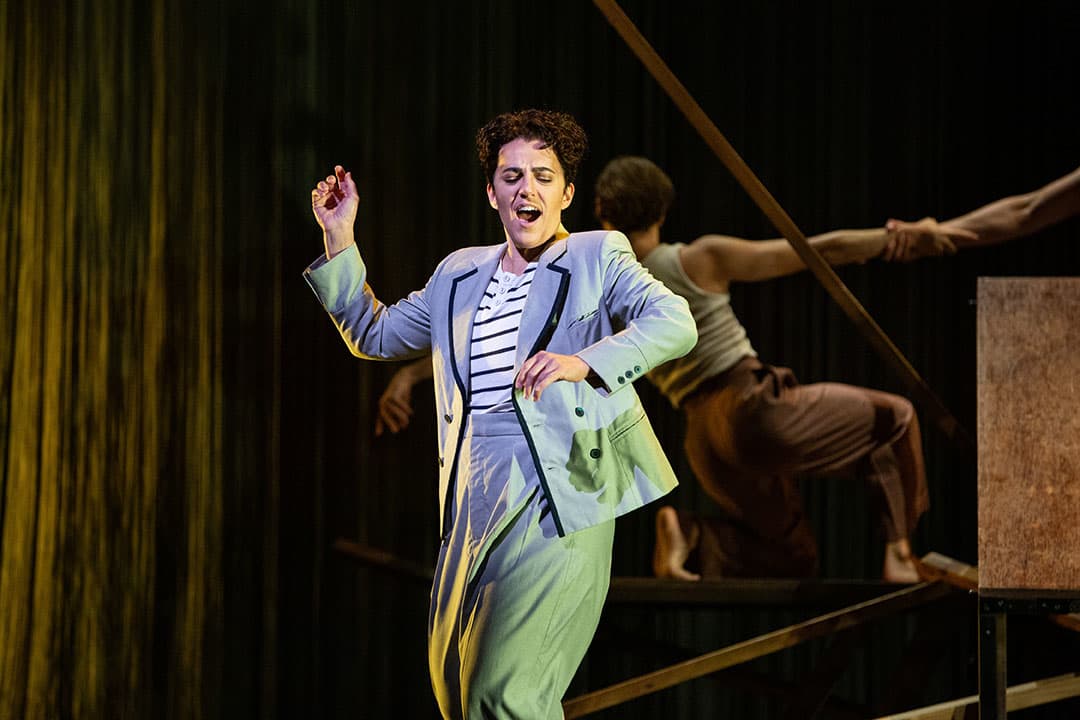
Tshilidzi Ndou and Craig Irvin in ‘The Pirates of Penzance.’

 PHOTO: BRENT DELANOY/THE GLIMMERGLASS FESTIVAL

Cooperstown, N.Y. 

The highlight of this season’s Glimmerglass Festival, a beguiling production of Francesco Cavalli’s “La Calisto” (1651), recalled the 1990s—when the company, then headed by Paul Kellogg, did a Baroque opera every year, setting off a vogue that other American houses would follow. Its 1996 “Calisto” featured Christine Goerke, now a renowned singer of Strauss and Wagner, among the leads. This year’s staging featured a stylish orchestral realization, including a few tastefully deployed wind and brass instruments, by Rob Ainsley, now in his second season as the festival’s artistic and general director. Mr. Ainsley conducted with brio from the keyboard with the support of a sensitive continuo section.

Craig Irvin and Emilie Kealani in ‘La Calisto.’PHOTO: SOFIA NEGRON / GLIMMERGLASS FESTIVAL

The show carefully balanced the opera’s serious and comic depictions of love. Jove disguises himself as the goddess Diana in order to have his way with Calisto, one of her virgin nymphs; Juno, Jove’s consort, is jealous; Endymion, a shepherd, is in love with Diana, who is tempted by him; Linfea, another nymph, is curious about sex. Emilie Kealani’s light, delicate soprano was ideal for the innocent Calisto, effectively contrasted with Taylor Raven’s voluptuous-toned Diana—both the real one and Jove-in-disguise. Mezzo SarahAnn Duffy, stepping in for an indisposed colleague, was poignant as the lovelorn Endymion; her tenderly passionate duets with Ms. Raven were high points in the show. Eve Gigliotti brought a ferocious intensity to Juno, who turns Calisto into a bear. Amanda Sheriff’s bright soprano and hilariously lewd acting and dancing turned the Young Satyr into a potent scene-stealer. As Jove, Craig Irvin was properly imperious, though less vocally stylish than the other singers.

Continue reading “Glimmerglass Festival Review: Between History and Fantasy”

Santa Fe Opera Review: Time-Swapped Tales of Love

The summer program includes the world premiere of ‘The Righteous’ along with four classics—‘Der Rosenkavalier,’ ‘La Traviata,’ ‘Don Giovanni’ and ‘The Elixir of Love’—brought closer to the present.

By 

Heidi Waleson

Aug. 5, 2024 at 6:15 pm ET

Michael Mayes and the Santa Fe Opera ensemble

 PHOTO: CURTIS BROWN

Santa Fe, N.M. 

“The Righteous,” having its world premiere at the Santa Fe Opera this summer, is the second collaboration of composer Gregory Spears and librettist Tracy K. Smith. Like their first, “Castor and Patience,” it is based on an original story with a complex, contemporary theme and a lot of potential. Set in the American Southwest between 1979 and 1990, it concerns a preacher, David (Michael Mayes), whose religious calling is tainted by his ambition and other personal flaws. However, like the earlier work, the opera is ensnared in a wordy and overly complicated libretto, with too many scenes and dramatic climaxes, especially in the second act, as well as numerous stretches of unoperatic exposition.

In a plot that covers races for governor and the expansion of David’s church against the backdrop of the Iran hostage crisis, AIDS and the crack epidemic, David’s actions and motives are questioned by three people who love him: Michele, his first wife (Jennifer Johnson Cano); Sheila, a parishioner with whom he has an affair and then marries (Elena Villalón); and Jonathan, Michele’s gay brother, who is also David’s longtime friend and would-be lover (Anthony Roth Costanzo). Their arias—though invariably too long—are the best moments in the opera, delving into their hearts with poetry and lyricism. But David is a cipher, and since Mr. Mayes, singing with a blaring, unsubtle baritone, doesn’t read as a handsome, charismatic young preacher, it is hard to understand their attraction to and belief in him. It’s a relief when they all break free at the end. Even though in the final aria (with chorus) David declares that “Life is long, and wisdom slow,” it’s not clear that he understands how his inability to love, as a Christian or a human, has been his downfall even as he has risen in the world.
Continue reading “Santa Fe Opera Review: Time-Swapped Tales of Love”

‘Le Prophète,’ ‘Anna di Resburgo’ and ‘I Capuleti e i Montecchi’ Reviews: Resurrections and Raucousness

At Bard SummerScape and Lincoln Center, three operas depict fiery conflicts and family feuds, from a Reformation-era religious rebellion to a timeless tale of ill-fated lovers.

By 

Heidi Waleson

July 30, 2024 at 4:58 pm ET

Jennifer Feinstein and Robert Watson in ‘Le Prophète.’

 PHOTO: ANDY HENDERSON

Annandale-on-Hudson, N.Y.

This season’s opera rarity at Bard SummerScape is Giacomo Meyerbeer’s “Le Prophète” (1849) in its first new American staging in nearly five decades (the Metropolitan Opera last put it on in 1979). French grand opera was the Ringling Brothers extravaganza of its era, and this one is a big show—five acts, nearly 3 1/2 hours of music, huge choruses, ballets, a trio of high-powered solo singers, plus dramatic scenic effects. Christian Räth’s astute production (through Aug. 4) shifted the 16th-century story, which has a historical basis, into the modern era: Jean de Leyde, manipulated by a trio of sinister Anabaptists into leading a rebellion that quickly spins out of control, could represent the pawn of any group that seeks to use religious zealotry for political ends.
It’s a riveting and rousing piece, in part because the libretto by Eugène Scribeand Émile Deschamps skillfully balances the personal and the political. Jean’s desire for revenge against the wicked aristocrat who abused Berthe, his fiancée, turns him into a tyrant who is even worse, destroying the innocents he loved and wanted to protect. One dramatic example among many is the lavish coronation scene, in which Jean declares himself the “Son of God” only to be swiftly undermined by the claims of Fidès, his beloved mother.

Continue reading “‘Le Prophète,’ ‘Anna di Resburgo’ and ‘I Capuleti e i Montecchi’ Reviews: Resurrections and Raucousness”

‘American Apollo,’ ‘Pelléas et Mélisande’ and ‘The Fairy Queen’ Reviews: Muses and Mirages at the Opera

Three operas portray the trancelike state of love, from a world-premiere production exploring the intimate bond between John Singer Sargent and his male studio model to Debussy’s classic tragedy and Purcell’s intoxicating adaptation of Shakespeare.

By Heidi Waleson

July 22, 2024 at 5:27 pm ET

Justin Austin and William Burden in ‘American Apollo.’

PHOTO: CORY WEAVER
Indianola, Iowa

“American Apollo” by Damien Geter and Lila Palmer, which had its world premiere at Des Moines Metro Opera earlier this month, touchingly imagines the artistic and erotic relationship between two real people. In 1916, the celebrated painter John Singer Sargent met Thomas McKeller, a young black man working as a bellhop and elevator operator at a Boston hotel. For the next decade, until the artist’s death in 1925, McKeller was Sargent’s model for his murals at the Museum of Fine Arts, his body transformed into those of gods and muses, both male and female. Sargent’s sketches of McKeller prompted a 2020 exhibition at the Isabella Stewart Gardner Museum accompanied by scholarly exploration of their story.

For DMMO, Mr. Geter and Ms. Palmer expanded their 20-minute piece commissioned by Washington National Opera’s American Opera Initiative into a full evening. There are extraneous characters, occasional talkiness, and some plot points that feel artificial, but when the creators delve into the emotional intimacy and fervor of the relationship, the opera blossoms. Ms. Palmer’s libretto deals forthrightly with the complexities of its central theme—the power imbalance between a prominent white man and a working-class black one, exemplified by the fact that Sargent’s MFA paintings of McKeller’s body show him as white, with classical heads instead of his own. Was Sargent simply using McKeller, or did he truly see and care for him?

Continue reading “‘American Apollo,’ ‘Pelléas et Mélisande’ and ‘The Fairy Queen’ Reviews: Muses and Mirages at the Opera”

‘Robeson’ Review: Davóne Tines as the Tortured Hero

At Little Island, the life and repertoire of the controversial singer, actor and activist Paul Robeson were explored in a new work performed by Mr. Tines and conceived by the bass-baritone and director Zack Winokur.

By Heidi Waleson 

July 1, 2024 at 5:30 pm ET

Khari Lucas and Davóne Tines.

 PHOTO: PHOTO: JULIETA CERVANTES

New York

Little Island, a park built out over the Hudson River, has jumped into the performing arts with a summer season that includes nine commissions. The dark themes of one of those, “Robeson,” presented in the 700-seat outdoor amphitheater on Friday, belied the pleasant atmosphere of the venue, with its river view and balmy breezes. Conceived by bass-baritone Davóne Tines and director Zack Winokur, “Robeson” is Mr. Tines’s extremely personal journey through the troubled legacy of his eminent black predecessor, the singer, actor and activist Paul Robeson (1898-1976). A version of it will be released on Nonesuch in September.

The hour-long show began with Mr. Tines channeling the historical Robeson, elegant in a tuxedo, informing his concert audience that the State Department had prevented him from traveling abroad for eight years. After singing a few songs, he shed his tuxedo jacket, turned back his cuffs, and recited Othello’s closing suicide monologue. Then things got surreal: On the final phrase—“and smote him thus”—he slashed his wrist with a knife and staggered over to a sink, trying to staunch the blood with a towel.

Continue reading “‘Robeson’ Review: Davóne Tines as the Tortured Hero”

‘Galileo Galilei,’ ‘Julius Caesar’ and ‘La Bohème’ Reviews: Opera History Made New

The Opera Theatre of Saint Louis presents a 2002 chamber work by Philip Glass, along with trimmed and translated Handel and Puccini stagings with a modern feel.

By 

Heidi Waleson

June 24, 2024 at 5:19 pm ET

Vanessa Becerra and Sean Michael Plumb in ‘Galileo.’

 PHOTO: ERIC WOOLSEY

Webster Groves, Mo.

Opera Theatre of Saint Louis makes a practice of reviving underperformed contemporary operas. This season’s example is Philip Glass’s “Galileo Galilei” (2002), a chamber piece that examines the courage of the scientist who challenged established orthodoxy. In the thoughtful libretto, written by Mary Zimmerman with Mr. Glass and Arnold Weinstein, Galileo, blind and near death in 1642, looks backward through his life: How the Catholic Church forced him to recant his heretical assertion that the Earth revolves around the stationary sun; at his early discoveries (mechanics, the refracting telescope); and when he attended, as a young child, an opera written by his father, a founder of the Florentine Camerata, the group of artists and intellectuals that invented opera. In an absorbing 90 minutes, Mr. Glass’s opera reflects wistfully on Galileo’s warm relationships with Cardinal Barberini (later Pope Urban VIII), who did not protect him, and with the scientist’s daughter, Maria Celeste, dispatched to a convent. Most poignantly, it stresses Galileo’s belief that inquiry and religion need not be at odds—“When we look, we see all of God’s perfection,” he tells his daughter—a view that remains controversial to this day.

Mr. Glass’s score, with its familiar churning rhythms, brightens as it moves back in time. Tenor Paul Groves brought a weighty weariness to Older Galileo; baritone Sean Michael Plumb was appropriately spirited as Younger Galileo; Vanessa Becerra was touching as his daughter, sending him pears from her convent garden. Countertenor Elijah English stood out in the trio of interrogating cardinals; Hunter Enoch’s powerful bass-baritone was used to good effect as Cardinal Barberini, a friend until he wasn’t. Conductor Kwamé Ryan kept the 13-member orchestra lively, if not always together.

Continue reading “‘Galileo Galilei,’ ‘Julius Caesar’ and ‘La Bohème’ Reviews: Opera History Made New”

‘The Comet / Poppea’ and ‘Innocence’ Reviews: Desperate Couples and Family Secrets

Yuval Sharon melds a modern work with Monteverdi in a staging at the Museum of Contemporary Art in Los Angeles; at the San Francisco Opera, Kaija Saariaho’s final opera is a both timely and timeless meditation on our capacity for evil.

By 

Heidi Waleson

June 18, 2024 at 5:19 pm ET

A scene from ‘Innocence’ at San Francisco Opera.

PHOTO: CORY WEAVER/SAN FRANCISCO OPERA

Los Angeles

Director Yuval Sharon shakes up opera—his groundbreaking “Hopscotch” (2015) performed in 24 cars driving around Los Angeles was just an opening salvo. In his current project, “The Comet / Poppea,” which had its world premiere at the Geffen Contemporary at MOCA on Friday, “The Comet,” a new score by George Lewis, is performed simultaneously with excerpts from Monteverdi’s “L’incoronazione di Poppea” (1643). Unlike John Cage’s “Europeras,” made up of random, superimposed operatic selections, which Mr. Sharon has staged in Los Angeles and Detroit, the result is not chaos, but rather two pieces that dovetail and at times speak to each other. The 80-minute show keeps the audience perpetually off balance, which seems to be the point.

In “Poppea,” the Roman emperor Nero and his manipulative mistress, Poppea, scheme to make her his wife and empress, destroying anyone who gets in their way. In Douglas Kearney’s libretto for “The Comet,” distilled from a 1920 story by W.E.B. Du Bois, a comet has seemingly killed everyone except Jim, a poor black man, and Julia, a rich white woman. Will they be able to overcome their racist conditioning and repopulate the world?

Continue reading “‘The Comet / Poppea’ and ‘Innocence’ Reviews: Desperate Couples and Family Secrets”

THE GUITAR RULES

            These reviews first appeared in The Quarterly of the Lute Society of America in significantly altered form.

The modern guitar dominates the commercial music we hear in the west. Since the time of Elvis Presley and the Beatles, bands made up of fretted instruments and percussion have become the convention in popular music. The tradition of the players of guitar being the stars of non-religious art music is a long one, and includes not only Spain, but France, Italy and England as well. The idea of the guitarist improvisor/composer/performer is also not a new one.

The baroque guitar is one of the several variations on historical fretted instruments, of which the most well know is probably the lute. The baroque guitar was in its time perhaps most widely heard accompanying comic arias in operas of the baroque. In Latin American music of the period, is can similarly be part of a jubilant rhythm section playing in the rasqueado (strummed) style. There is a substantial solo repertoire of secular music, some of which is now played by modern guitarists. But the instrument remains somewhat obscure in the modern world, especially since it is difficult to perform as a soloist in public under contemporary concert circumstances due to its lack of capacity to project and the low volume of sound it produces (particularly when played in the punteado (or plucked) style.  But digital recordings are a godsend for this music, because of the immediacy made possible by the microphone and the ability to crank up the volume, if one so desires. 

            It is therefore particularly remarkable, given the relative invisibilty of the instrument in the wider world that so many recordings of the baroque guitar and its music have landed in the “in-box” of the LSA in recent years. Musicians seeking to perform this music must not only become expert in the appropriate style, rhetoric and ornamentation for the genre, but they often must create their own performing editions from manuscripts or period printings. Clearly, playing this music, like most of early music for fretted instruments, is a labor of love – and certainly not a dry scholarly exercise. Several of the performers, playing at a high level of technique and sophistication, are names that were previously unknown to me. What follows is a report on the several disks that have piled up at the LSA featuring the historical guitar. 

Continue reading “THE GUITAR RULES”