‘Le Prophète,’ ‘Anna di Resburgo’ and ‘I Capuleti e i Montecchi’ Reviews: Resurrections and Raucousness

At Bard SummerScape and Lincoln Center, three operas depict fiery conflicts and family feuds, from a Reformation-era religious rebellion to a timeless tale of ill-fated lovers.

By 

Heidi Waleson

July 30, 2024 at 4:58 pm ET

Jennifer Feinstein and Robert Watson in ‘Le Prophète.’

 PHOTO: ANDY HENDERSON

Annandale-on-Hudson, N.Y.

This season’s opera rarity at Bard SummerScape is Giacomo Meyerbeer’s “Le Prophète” (1849) in its first new American staging in nearly five decades (the Metropolitan Opera last put it on in 1979). French grand opera was the Ringling Brothers extravaganza of its era, and this one is a big show—five acts, nearly 3 1/2 hours of music, huge choruses, ballets, a trio of high-powered solo singers, plus dramatic scenic effects. Christian Räth’s astute production (through Aug. 4) shifted the 16th-century story, which has a historical basis, into the modern era: Jean de Leyde, manipulated by a trio of sinister Anabaptists into leading a rebellion that quickly spins out of control, could represent the pawn of any group that seeks to use religious zealotry for political ends.

It’s a riveting and rousing piece, in part because the libretto by Eugène Scribeand Émile Deschamps skillfully balances the personal and the political. Jean’s desire for revenge against the wicked aristocrat who abused Berthe, his fiancée, turns him into a tyrant who is even worse, destroying the innocents he loved and wanted to protect. One dramatic example among many is the lavish coronation scene, in which Jean declares himself the “Son of God” only to be swiftly undermined by the claims of Fidès, his beloved mother.

Continue reading “‘Le Prophète,’ ‘Anna di Resburgo’ and ‘I Capuleti e i Montecchi’ Reviews: Resurrections and Raucousness”

‘American Apollo,’ ‘Pelléas et Mélisande’ and ‘The Fairy Queen’ Reviews: Muses and Mirages at the Opera

Three operas portray the trancelike state of love, from a world-premiere production exploring the intimate bond between John Singer Sargent and his male studio model to Debussy’s classic tragedy and Purcell’s intoxicating adaptation of Shakespeare.

By Heidi Waleson

July 22, 2024 at 5:27 pm ET

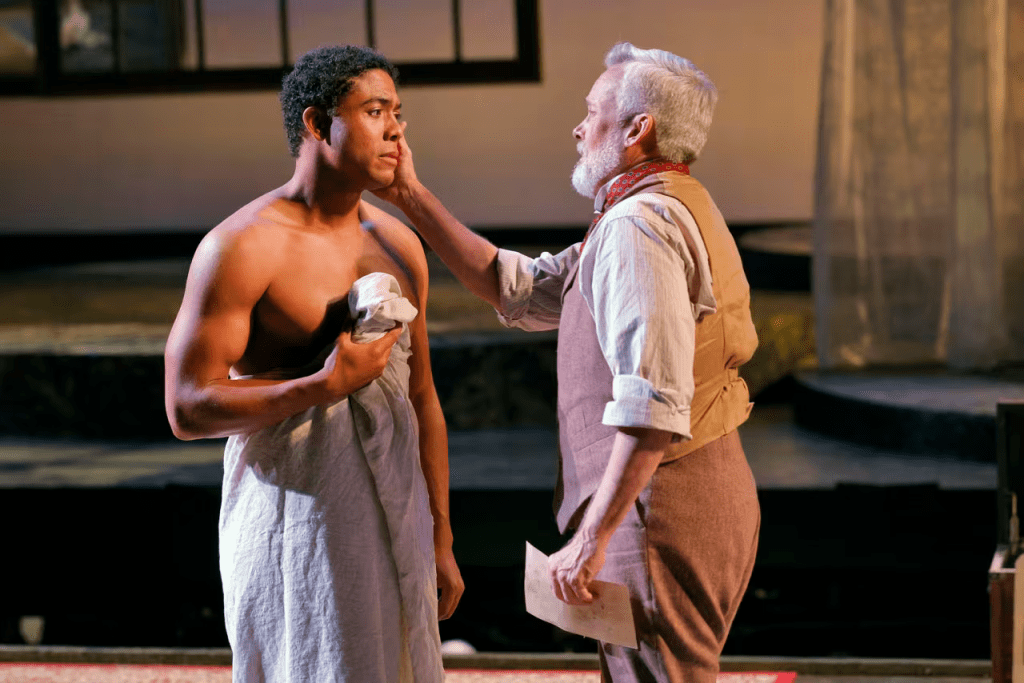
Justin Austin and William Burden in ‘American Apollo.’

PHOTO: CORY WEAVER
Indianola, Iowa

“American Apollo” by Damien Geter and Lila Palmer, which had its world premiere at Des Moines Metro Opera earlier this month, touchingly imagines the artistic and erotic relationship between two real people. In 1916, the celebrated painter John Singer Sargent met Thomas McKeller, a young black man working as a bellhop and elevator operator at a Boston hotel. For the next decade, until the artist’s death in 1925, McKeller was Sargent’s model for his murals at the Museum of Fine Arts, his body transformed into those of gods and muses, both male and female. Sargent’s sketches of McKeller prompted a 2020 exhibition at the Isabella Stewart Gardner Museum accompanied by scholarly exploration of their story.

For DMMO, Mr. Geter and Ms. Palmer expanded their 20-minute piece commissioned by Washington National Opera’s American Opera Initiative into a full evening. There are extraneous characters, occasional talkiness, and some plot points that feel artificial, but when the creators delve into the emotional intimacy and fervor of the relationship, the opera blossoms. Ms. Palmer’s libretto deals forthrightly with the complexities of its central theme—the power imbalance between a prominent white man and a working-class black one, exemplified by the fact that Sargent’s MFA paintings of McKeller’s body show him as white, with classical heads instead of his own. Was Sargent simply using McKeller, or did he truly see and care for him?

Continue reading “‘American Apollo,’ ‘Pelléas et Mélisande’ and ‘The Fairy Queen’ Reviews: Muses and Mirages at the Opera”

‘Robeson’ Review: Davóne Tines as the Tortured Hero

At Little Island, the life and repertoire of the controversial singer, actor and activist Paul Robeson were explored in a new work performed by Mr. Tines and conceived by the bass-baritone and director Zack Winokur.

By Heidi Waleson 

July 1, 2024 at 5:30 pm ET

Khari Lucas and Davóne Tines.

 PHOTO: PHOTO: JULIETA CERVANTES

New York

Little Island, a park built out over the Hudson River, has jumped into the performing arts with a summer season that includes nine commissions. The dark themes of one of those, “Robeson,” presented in the 700-seat outdoor amphitheater on Friday, belied the pleasant atmosphere of the venue, with its river view and balmy breezes. Conceived by bass-baritone Davóne Tines and director Zack Winokur, “Robeson” is Mr. Tines’s extremely personal journey through the troubled legacy of his eminent black predecessor, the singer, actor and activist Paul Robeson (1898-1976). A version of it will be released on Nonesuch in September.

The hour-long show began with Mr. Tines channeling the historical Robeson, elegant in a tuxedo, informing his concert audience that the State Department had prevented him from traveling abroad for eight years. After singing a few songs, he shed his tuxedo jacket, turned back his cuffs, and recited Othello’s closing suicide monologue. Then things got surreal: On the final phrase—“and smote him thus”—he slashed his wrist with a knife and staggered over to a sink, trying to staunch the blood with a towel.

Continue reading “‘Robeson’ Review: Davóne Tines as the Tortured Hero”

‘Galileo Galilei,’ ‘Julius Caesar’ and ‘La Bohème’ Reviews: Opera History Made New

The Opera Theatre of Saint Louis presents a 2002 chamber work by Philip Glass, along with trimmed and translated Handel and Puccini stagings with a modern feel.

By 

Heidi Waleson

June 24, 2024 at 5:19 pm ET

Vanessa Becerra and Sean Michael Plumb in ‘Galileo.’

 PHOTO: ERIC WOOLSEY

Webster Groves, Mo.

Opera Theatre of Saint Louis makes a practice of reviving underperformed contemporary operas. This season’s example is Philip Glass’s “Galileo Galilei” (2002), a chamber piece that examines the courage of the scientist who challenged established orthodoxy. In the thoughtful libretto, written by Mary Zimmerman with Mr. Glass and Arnold Weinstein, Galileo, blind and near death in 1642, looks backward through his life: How the Catholic Church forced him to recant his heretical assertion that the Earth revolves around the stationary sun; at his early discoveries (mechanics, the refracting telescope); and when he attended, as a young child, an opera written by his father, a founder of the Florentine Camerata, the group of artists and intellectuals that invented opera. In an absorbing 90 minutes, Mr. Glass’s opera reflects wistfully on Galileo’s warm relationships with Cardinal Barberini (later Pope Urban VIII), who did not protect him, and with the scientist’s daughter, Maria Celeste, dispatched to a convent. Most poignantly, it stresses Galileo’s belief that inquiry and religion need not be at odds—“When we look, we see all of God’s perfection,” he tells his daughter—a view that remains controversial to this day.

Mr. Glass’s score, with its familiar churning rhythms, brightens as it moves back in time. Tenor Paul Groves brought a weighty weariness to Older Galileo; baritone Sean Michael Plumb was appropriately spirited as Younger Galileo; Vanessa Becerra was touching as his daughter, sending him pears from her convent garden. Countertenor Elijah English stood out in the trio of interrogating cardinals; Hunter Enoch’s powerful bass-baritone was used to good effect as Cardinal Barberini, a friend until he wasn’t. Conductor Kwamé Ryan kept the 13-member orchestra lively, if not always together.

Continue reading “‘Galileo Galilei,’ ‘Julius Caesar’ and ‘La Bohème’ Reviews: Opera History Made New”

‘The Comet / Poppea’ and ‘Innocence’ Reviews: Desperate Couples and Family Secrets

Yuval Sharon melds a modern work with Monteverdi in a staging at the Museum of Contemporary Art in Los Angeles; at the San Francisco Opera, Kaija Saariaho’s final opera is a both timely and timeless meditation on our capacity for evil.

By 

Heidi Waleson

June 18, 2024 at 5:19 pm ET

A scene from ‘Innocence’ at San Francisco Opera.

PHOTO: CORY WEAVER/SAN FRANCISCO OPERA

Los Angeles

Director Yuval Sharon shakes up opera—his groundbreaking “Hopscotch” (2015) performed in 24 cars driving around Los Angeles was just an opening salvo. In his current project, “The Comet / Poppea,” which had its world premiere at the Geffen Contemporary at MOCA on Friday, “The Comet,” a new score by George Lewis, is performed simultaneously with excerpts from Monteverdi’s “L’incoronazione di Poppea” (1643). Unlike John Cage’s “Europeras,” made up of random, superimposed operatic selections, which Mr. Sharon has staged in Los Angeles and Detroit, the result is not chaos, but rather two pieces that dovetail and at times speak to each other. The 80-minute show keeps the audience perpetually off balance, which seems to be the point.

In “Poppea,” the Roman emperor Nero and his manipulative mistress, Poppea, scheme to make her his wife and empress, destroying anyone who gets in their way. In Douglas Kearney’s libretto for “The Comet,” distilled from a 1920 story by W.E.B. Du Bois, a comet has seemingly killed everyone except Jim, a poor black man, and Julia, a rich white woman. Will they be able to overcome their racist conditioning and repopulate the world?

Continue reading “‘The Comet / Poppea’ and ‘Innocence’ Reviews: Desperate Couples and Family Secrets”

THE GUITAR RULES

            These reviews first appeared in The Quarterly of the Lute Society of America in significantly altered form.

The modern guitar dominates the commercial music we hear in the west. Since the time of Elvis Presley and the Beatles, bands made up of fretted instruments and percussion have become the convention in popular music. The tradition of the players of guitar being the stars of non-religious art music is a long one, and includes not only Spain, but France, Italy and England as well. The idea of the guitarist improvisor/composer/performer is also not a new one.

The baroque guitar is one of the several variations on historical fretted instruments, of which the most well know is probably the lute. The baroque guitar was in its time perhaps most widely heard accompanying comic arias in operas of the baroque. In Latin American music of the period, is can similarly be part of a jubilant rhythm section playing in the rasqueado (strummed) style. There is a substantial solo repertoire of secular music, some of which is now played by modern guitarists. But the instrument remains somewhat obscure in the modern world, especially since it is difficult to perform as a soloist in public under contemporary concert circumstances due to its lack of capacity to project and the low volume of sound it produces (particularly when played in the punteado (or plucked) style.  But digital recordings are a godsend for this music, because of the immediacy made possible by the microphone and the ability to crank up the volume, if one so desires. 

            It is therefore particularly remarkable, given the relative invisibilty of the instrument in the wider world that so many recordings of the baroque guitar and its music have landed in the “in-box” of the LSA in recent years. Musicians seeking to perform this music must not only become expert in the appropriate style, rhetoric and ornamentation for the genre, but they often must create their own performing editions from manuscripts or period printings. Clearly, playing this music, like most of early music for fretted instruments, is a labor of love – and certainly not a dry scholarly exercise. Several of the performers, playing at a high level of technique and sophistication, are names that were previously unknown to me. What follows is a report on the several disks that have piled up at the LSA featuring the historical guitar. 

Continue reading “THE GUITAR RULES”

La Serenissima – Italian Music for Lute (and others)

These reviews first appeared in The Quarterly of the Lute Society of America in significantly altered form.

La Suave Melodia, Performance Practice in Italy 1600-1660, Ensemble Badinerie, Rahel Stoellger, flauto dolce, William Dongois. Cornetto, 68’09, 21 tracks, Accent Plus ACC10401, Recorded 2000, released 2010

Arguably, modern western musical harmony was born in and around the Veneto in Italy around 1605. Venice was in economic decline, it’s 700-year history as the portal between the world of the Byzantine world and the European was coming to an end. The militarily defensive value of being an island city state, and Venice’s form of maritime technology were being eclipsed by the financial and commodity traders in Amsterdam and London, and the multi-masted sailing goliaths being built elsewhere than Italy. 

And yet there was Venice as a magnet for musicians from all over the continent at that time. With its epicenter at the oddly shaped San Marco basilica (not even a Cathedral), where for decades Claudio Monteverdi reigned supreme after 1613. Cavalli, Schutz, Gabrielli all were associated with the Basilica at one time, and this musical flowering had reach – including courts as far away as Naples and as near as Mantua, Brescia and Milan. This disk of chamber music includes recorder, cornett, dulcian, keyboard and lute. The terminology regarding organology can be, as we know both confusing and inconsistent, as they are here. The notes to the recording make reference to cembalo, positive organ, zink, bassoon, theorbo and baroque guitar. The lutenist is Karl-Ernst Schröder, whose instruments are a Richard Earle “theorbo”, and a Peter Biffin “gitarre.”

The recording features excellent ensemble playing by the Badineries, led by Vienna-based recorder player Rachel Stoellger. This is secular instrumental music from the first half of the 17th century, repertoire of which we don’t hear enough. This was chamber music, some of which was composed to be played in the great scuola of Venice. The scuola were more guilds than schools and were fabulously decorated by the leading painters primarily of the 16th Century, the most famous of which is the scuola San Rocco, decorated with breath-taking paintings by Tinteretto. Being among the wealthy citizens of Venice attending concerts in this space must have been an fine experience. And this recording gives a satisfying taste of what that must have been like. Something quite different from the grand music of the opera house and church of this period with which we are more familiar. The composers on the recording are unfamiliar names, except for Merula – who contributes a “Ciacona,” which, given the basic descending bass pattern of the chiccone and the nature of improvisatory performance practice of the period, could have been by anyone! The other pieces take the form of sonatas and dances.

A particularly interesting aspect of these performances is the high visibility of the bassoon (played with brio and skill by Christian Beuse), which is not just a participant in the continuo section, but also a virtuosic soloist. The theorbo, by contrast is inaudible, and the guitar plays a percussive part under the playing of the passacaglio and the ciacona. The recorder was not part of the ensemble at San Marco during this period, and so the sonatas for soprano recorder were a showcase. The sonata was a newish name for a musical form at this time, and these works are of a type that are the germ of what became a long history of art music composed for small ensembles. The compositional style generally features parallel lines (often in thirds) over a harmony created by a figured bass. Polyphony is in the past. Modern harmony is in the future. Here is a very well-presented kernel of the musical future from, perhaps, the most important transitional period in Western musical history, created for artistically remarkable spaces, during the closing years of the long run of an empire of previously unsurpassed wealth and global power.

Settecento, Baroque Instrumental Music from the Italian States, La Serenissima, Adrian Chandler director/violin, Tabera Debus recorder, 27 tracks, 70’48, Signum Records SIGCD663; 2021

We’ve come a long way since what was once called the “sewing machine” music of Il Soloisti Venti of the 1950’s performances of baroque music for mostly strings on modern instruments, with steel strings. This recording of English ensemble, La Serenissima, is an exemplary example of contemporary string band performance practice, under the direction of violinist, Adrian Chandler. Following in Monteverdi’s wake, Italy from about 1650 to about 1740 flowered with talented string players (and instrument makers!), and the repertoire for them is vast and diverse – featuring a wide range of concerted instruments. 

Chandler’s playing is lively and precisely pitched, and his leadership is spirited. There is a guest appearance of a half dozen of the tracks of English Lute Society stalwart, Lynda Sayce on theorbo and baroque guitar in the continuo group. The disk includes music of the first half of the 18th Century by composers both of La Serenissima itself (Venice) and of the Kingdom of Naples. The composers include Alessandro Scarlatti, Tartini and Vivaldi, but also the less familiar names of Dall’Abaco, Vandini, Mancini, Brescianello. The seven included works are six in sonata form and one concerto for recorder and two violins. Two of the sonatas are also for recorder and two violins; one sonata is for cello, one is for two violins and two are for solo violin. All are scored with continuo, performed mostly with harpsichord. 

The music presented here is wonderfully engaging in these performances. Chandler is an impressively virtuosic player, with great flair and theatricality, without excess, and his note in the CD package in quite interesting about the manuscript sources of the scores. Tabera Debus (who teaches at the school of the Wells Cathedral – a very cool gig!) is equally impressive and refined in the works for recorder. The tracks featuring the interplay of recorder and violin are the standouts on the album and are particularly enjoyable. There are seven players involved in this recording, and they make a full, rich, stylish sound together. Unfortunately, in the works calling for a larger band, the ensemble work can tend toward the insufficiently well-coordinated. But otherwise, the music making is bright, clear and pleasing. 

Chandler has made thirteen recordings with the group, which, to my best knowledge, has not performed in the U.S. Why not? 

Continue reading “La Serenissima – Italian Music for Lute (and others)”

Spoleto Festival USA Review: Timely Opera and Ancient Drama

‘Ruinous Gods’ struggles to find musical or narrative coherence in its depiction of the toll forced migration takes on children; Denis O’Hare and Lisa Peterson’s ‘The Song of Rome’ offers a sophisticated modern spin on Virgil’s ‘Aeneid.

By Heidi Waleson

May 29, 2024 at 3:11 pm ET


Karim Sulayman

 PHOTO: WILLIAM STRUHS

Charleston, S.C.

In the past, Spoleto Festival USA mounted several opera-related projects each spring; this year the Festival, which is now headed by Mena Mark Hanna, has only one: the world premiere of “Ruinous Gods” by composer Layale Chakerand librettist Lisa Schlesinger. Both are newcomers to the form, and it shows. The piece, which tackles a timely subject—the toll that forced migration takes on children—is structurally incoherent and narratively amorphous; it misses the target.

Ms. Schlesinger, a playwright, found her subject in a 2017 New Yorker article about “resignation syndrome,” a malady in which refugee children facing deportation from Sweden fell into an unresponsive sleep lasting months or even years. The libretto imagines such a sleeper, H’ala, on a journey to the Underworld, or perhaps Purgatory. Accompanied by Crow (a bird), she meets other sleepers who tell their stories of displacement. This central sequence is bookended by scenes that have a pair of doctors proposing treatments, and H’ala’s mother, Hannah, decrying the circumstances that brought them to this pass.

Continue reading “Spoleto Festival USA Review: Timely Opera and Ancient Drama”

SEMPER DOWLAND

These reviews first appeared in The Quarterly of the Lute Society of America in significantly altered form.

John Dowland (1563-1636) is indisputably the premier composer for the lute. He led a peripatetic life around Europe, including a decade in Denmark as the court lutenist, which brought a cosmopolitan experience to his composing. He was a master of both melody and polyphony, in a counter-reformationary, post-Council of Trent movement in European music away from the complexity of polyphony and the obscuring of text to monody and the highlighting of text. While Monteverdi was inventing modern harmony down in Italy, Dowland was writing secular songs, with complex accompaniments. In the 70’s Diane Poulton edited and published over 200 solo works for lute ascribed by her to him in the now standard edition. 

            Dowland spent years on the road because it wasn’t until late in life that he became court lutenist in England under James I. During the reign of Good Queen Bess, that brass ring eluded him. This was probably due in part to co-catholic religionist, William Byrd’s opposition to his appointment. But like Shakespeare, Byrd defines for us now Elizabethan culture. The word most often used to describe Dowland’s oeuvre is “melancholy,” and the lacrimea is probably his defining form. His songs and solo pieces are generally short but packed with melodic and polyphonic originality. 

Continue reading “SEMPER DOWLAND”

‘Turandot’ and ‘Shall We Gather at the River’ Reviews: Classics in New Contexts

Washington National Opera performed a world premiere production of Puccini’s work with a new final scene by Susan Soon He Stanton and Christopher Tin; at Park Avenue Armory, Peter Sellars directed a program of Bach cantatas and African-American spirituals presented as a call to action against climate change.

By 

Heidi Waleson

May 22, 2024 at 2:46 pm ET

Ewa Plonka (center) in ‘Turandot.’

PHOTO: CORY WEAVER

Washington

Although Puccini’s “Turandot” and “Madama Butterfly” are under fire lately for their stereotypical depictions of Asian characters, opera companies are reluctant to eliminate these hugely popular titles from their seasons. Productions that finesse the offensive elements offer one solution, but Washington National Opera has gone one step further.

Puccini died before he could finish “Turandot,” so the final scene—in which the bloodthirsty princess Turandot and her determined suitor Calaf get happily wed—was composed by Franco Alfano. The music is pedestrian and the resolution hurried and unsatisfactory—he kisses her, she melts. Francesca Zambello, WNO’s artistic director, has always wanted an ending that gives Turandot more agency, so she commissioned one. The resulting production, which sold out all its performances in advance, is currently at the Kennedy Center.

The new final scene by librettist Susan Soon He Stanton, known for her work on “Succession,” and Christopher Tin, who writes scores for videogames as well as concert music, fits the opera neatly. Its sound and attitude, while contemporary, grow organically from Puccini’s original, like a savvy modern addition on a historic building. Ms. Stanton’s libretto gives Turandot extra back story—she, like her ancestor, was raped and abducted, fueling her determination to punish men. It also kills off the aged Emperor, so Calaf asks Turandot, now the ruler, to choose between a reign of death or one of life.

Mr. Tin launches their confrontation with a fiercely dramatic duet; the sound is edgier than Puccini but still tonal, and Turandot’s initial insistence on power through violence is Wagnerian in scope and accompanied by blaring brass. Calaf counters with lyricism; he tells her his name to a reprise of the “Nessun dorma” tune, and asks her to choose mercy and love—which, eventually, she does. Other Puccini quotations bubble up—the hymn of praise to the emperor; Liù’s rising line as Turandot, in her turn, chooses “amore,” more “Nessun dorma”—but Mr. Tin doesn’t lean on them. In fact, the concluding joyful chorus sounds more like the anthem from “Les Misérables.” The composer happily enlists Puccini’s big orchestra and chorus, and the whole thing runs about 15 minutes, barely longer than the Alfano version, but with a lot more content packed in.

Yonghoon Lee and Masabane Cecilia Rangwanasha

PHOTO: CORY WEAVER

The new ending also works because Ms. Zambello’s production updates the story from its fairy-tale origins to a contemporary totalitarian state. Wilson Chin’s set of looming industrial structures, their bars giving off a prison-like vibe, and Amith Chandrashaker’s lighting, with its shadowy grays, blaring fluorescent whites and lurid reds, all suggest a very unhappy place. The “people of Peking” are unhoused, suitcase-toting migrants; the soldiers, almost all women, wear Chinese Communist-like uniforms (Linda Cho did the costumes); Ping, Pang and Pong (here given the job titles Chancellor, Majordomo and Head Chef instead of those names) have modern suits, overcoats and fedoras. Turandot’s blood-red dress in Act 2 is a fitting complement to the stained knife hanging from the omnipresent guillotine; Jessica Lang and Kanji Segawa’s choreography for a nonet of soldiers recalls “The Red Detachment of Women.” The ending suggests, hopefully, that Turandot will be an enlightened ruler. It is, after all, still a fairy tale.

Ms. Plonka and Mr. Lee

PHOTO: CORY WEAVER

Ewa Plonka was a steely, imposing Turandot. Yonghoon Lee’s handsome tenor was appealing in Calaf’s tender “Non piangere, Liù,” but more frequently he punished it, pushing into brutal extremes of volume. Masabane Cecilia Rangwanasha was a riveting Liù, her warm, rounded soprano especially poignant in her death scene. Peixin Chen was an affecting Timur. Ethan Vincent, Sahel Salam and Jonathan Pierce Rhodes (Chancellor, Majordomo and Head Chef) made a sweet moment of their Act 2 trio; when placed upstage in the crowd scenes, they were hard to hear. As the Mandarin, Le Bu’s potent bass-baritone leaped out of the texture.

Veteran tenor Neil Shicoff had a notable cameo as the Emperor; his tenor is still powerful, and his halting climb to his throne—and his interpolated collapse—signaled the ruler’s age and infirmity. The chorus sang forcefully; the children’s chorus, chillingly outfitted as young soldiers, shone. Conductor Speranza Scappucci tended to drive the tempi; the evening was sometimes a bit breathless, but exciting overall.


New York

“Shall We Gather at the River,” a world premiere presented on May 21 at the Park Avenue Armory, was billed as a musical call to action against climate change. Directed by Peter Sellars and presented in conjunction with “Coal + Ice,” a photography and video show on the subject now at the Asia Society Museum, the performance featured three Bach cantatas and five black American spirituals, minimally staged with dancers and accompanied by projections of works selected from the exhibition.

Those projections—including forest wildfires, retreating glaciers, slag heaps and, most powerfully, videos of people standing waist-deep in their flooded homes and streets—told some of the story. Otherwise, one had to rely on the program notes and extrapolate the message about humans despoiling the planet, since Cantata BWV 39 is a call to share affluence with the less fortunate; BWV 26 is about the emptiness of worldly riches; and BWV 20 depicts the horror of eternal damnation. The spirituals emphasized the endurance of suffering in this world, repentance, and the hope for a better life on the other side.

The cantatas were impressively performed by the period ensemble Oxford Bach Soloists, the Choir of Trinity Wall Street and an excellent quartet of solo singers—Molly Quinn, Reginald Mobley, Nick Pritchard and Jonathan Woody. Tom Hammond-Davies was the sensitive conductor. Mr. Mobley, a countertenor, sang the spirituals with clarity and fervor. Wu Tong played the haunting introductory meditation on a sheng, a Chinese polyphonic reed instrument; its sound seemed to come from different directions in the darkened expanses of the Wade Thompson Drill Hall (Mark Grey did the sound design). Set and lighting designer Seth Reiser’s minimalist platform allowed for some changes of position by the singers and featured instrumentalists. The “flexn” choreography (a street-dance style) of Reggie “Regg Roc” Gray and four other dancers, with its hyperextended joints and twisting movements, communicated the anguish of the texts—a bit too viscerally—to the observers. Perhaps they were intended to evoke the suffering of the planet; with Mr. Sellars, one can never tell.
Ms. Waleson writes on opera for the Journal and is the author of “Mad Scenes and Exit Arias: The Death of the New York City Opera and the Future of Opera in America” (Metropolitan).