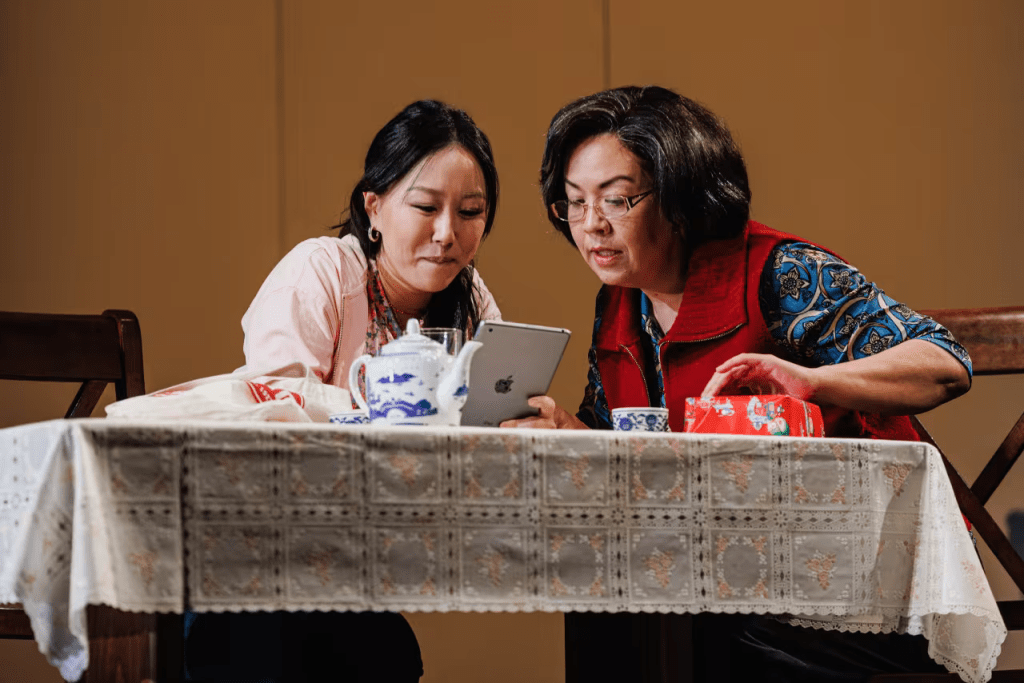
The Opera Theatre of Saint Louis presents a 2002 chamber work by Philip Glass, along with trimmed and translated Handel and Puccini stagings with a modern feel.
By
Heidi Waleson
June 24, 2024 at 5:19 pm ET
Vanessa Becerra and Sean Michael Plumb in ‘Galileo.’
PHOTO: ERIC WOOLSEY
Webster Groves, Mo.
Opera Theatre of Saint Louis makes a practice of reviving underperformed contemporary operas. This season’s example is Philip Glass’s “Galileo Galilei” (2002), a chamber piece that examines the courage of the scientist who challenged established orthodoxy. In the thoughtful libretto, written by Mary Zimmerman with Mr. Glass and Arnold Weinstein, Galileo, blind and near death in 1642, looks backward through his life: How the Catholic Church forced him to recant his heretical assertion that the Earth revolves around the stationary sun; at his early discoveries (mechanics, the refracting telescope); and when he attended, as a young child, an opera written by his father, a founder of the Florentine Camerata, the group of artists and intellectuals that invented opera. In an absorbing 90 minutes, Mr. Glass’s opera reflects wistfully on Galileo’s warm relationships with Cardinal Barberini (later Pope Urban VIII), who did not protect him, and with the scientist’s daughter, Maria Celeste, dispatched to a convent. Most poignantly, it stresses Galileo’s belief that inquiry and religion need not be at odds—“When we look, we see all of God’s perfection,” he tells his daughter—a view that remains controversial to this day.
Mr. Glass’s score, with its familiar churning rhythms, brightens as it moves back in time. Tenor Paul Groves brought a weighty weariness to Older Galileo; baritone Sean Michael Plumb was appropriately spirited as Younger Galileo; Vanessa Becerra was touching as his daughter, sending him pears from her convent garden. Countertenor Elijah English stood out in the trio of interrogating cardinals; Hunter Enoch’s powerful bass-baritone was used to good effect as Cardinal Barberini, a friend until he wasn’t. Conductor Kwamé Ryan kept the 13-member orchestra lively, if not always together.
Yuval Sharon melds a modern work with Monteverdi in a staging at the Museum of Contemporary Art in Los Angeles; at the San Francisco Opera, Kaija Saariaho’s final opera is a both timely and timeless meditation on our capacity for evil.
By
Heidi Waleson
June 18, 2024 at 5:19 pm ET
A scene from ‘Innocence’ at San Francisco Opera.
PHOTO: CORY WEAVER/SAN FRANCISCO OPERA
Los Angeles
Director Yuval Sharon shakes up opera—his groundbreaking “Hopscotch” (2015) performed in 24 cars driving around Los Angeles was just an opening salvo. In his current project, “The Comet / Poppea,” which had its world premiere at the Geffen Contemporary at MOCA on Friday, “The Comet,” a new score by George Lewis, is performed simultaneously with excerpts from Monteverdi’s “L’incoronazione di Poppea” (1643). Unlike John Cage’s “Europeras,” made up of random, superimposed operatic selections, which Mr. Sharon has staged in Los Angeles and Detroit, the result is not chaos, but rather two pieces that dovetail and at times speak to each other. The 80-minute show keeps the audience perpetually off balance, which seems to be the point.
In “Poppea,” the Roman emperor Nero and his manipulative mistress, Poppea, scheme to make her his wife and empress, destroying anyone who gets in their way. In Douglas Kearney’s libretto for “The Comet,” distilled from a 1920 story by W.E.B. Du Bois, a comet has seemingly killed everyone except Jim, a poor black man, and Julia, a rich white woman. Will they be able to overcome their racist conditioning and repopulate the world?
These reviews first appeared in The Quarterly of the Lute Society of America in significantly altered form.
The modern guitar dominates the commercial music we hear in the west. Since the time of Elvis Presley and the Beatles, bands made up of fretted instruments and percussion have become the convention in popular music. The tradition of the players of guitar being the stars of non-religious art music is a long one, and includes not only Spain, but France, Italy and England as well. The idea of the guitarist improvisor/composer/performer is also not a new one.
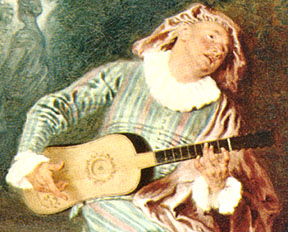
The baroque guitar is one of the several variations on historical fretted instruments, of which the most well know is probably the lute. The baroque guitar was in its time perhaps most widely heard accompanying comic arias in operas of the baroque. In Latin American music of the period, is can similarly be part of a jubilant rhythm section playing in the rasqueado (strummed) style. There is a substantial solo repertoire of secular music, some of which is now played by modern guitarists. But the instrument remains somewhat obscure in the modern world, especially since it is difficult to perform as a soloist in public under contemporary concert circumstances due to its lack of capacity to project and the low volume of sound it produces (particularly when played in the punteado (or plucked) style. But digital recordings are a godsend for this music, because of the immediacy made possible by the microphone and the ability to crank up the volume, if one so desires.
It is therefore particularly remarkable, given the relative invisibilty of the instrument in the wider world that so many recordings of the baroque guitar and its music have landed in the “in-box” of the LSA in recent years. Musicians seeking to perform this music must not only become expert in the appropriate style, rhetoric and ornamentation for the genre, but they often must create their own performing editions from manuscripts or period printings. Clearly, playing this music, like most of early music for fretted instruments, is a labor of love – and certainly not a dry scholarly exercise. Several of the performers, playing at a high level of technique and sophistication, are names that were previously unknown to me. What follows is a report on the several disks that have piled up at the LSA featuring the historical guitar.
These reviews first appeared in The Quarterly of the Lute Society of America in significantly altered form.
La Suave Melodia, Performance Practice in Italy 1600-1660, Ensemble Badinerie, Rahel Stoellger, flauto dolce, William Dongois. Cornetto, 68’09, 21 tracks, Accent Plus ACC10401, Recorded 2000, released 2010
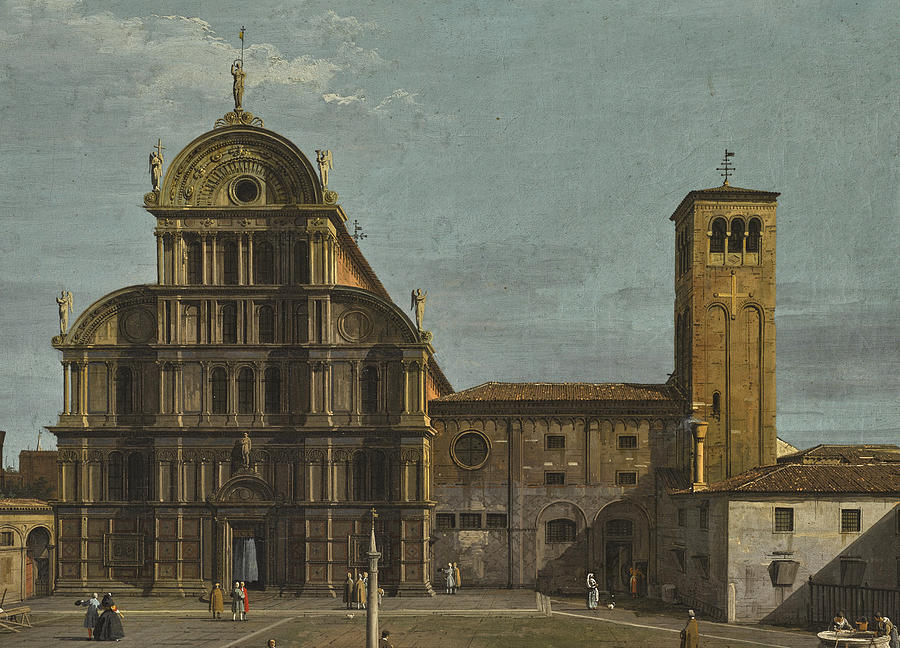
Arguably, modern western musical harmony was born in and around the Veneto in Italy around 1605. Venice was in economic decline, it’s 700-year history as the portal between the world of the Byzantine world and the European was coming to an end. The militarily defensive value of being an island city state, and Venice’s form of maritime technology were being eclipsed by the financial and commodity traders in Amsterdam and London, and the multi-masted sailing goliaths being built elsewhere than Italy.
And yet there was Venice as a magnet for musicians from all over the continent at that time. With its epicenter at the oddly shaped San Marco basilica (not even a Cathedral), where for decades Claudio Monteverdi reigned supreme after 1613. Cavalli, Schutz, Gabrielli all were associated with the Basilica at one time, and this musical flowering had reach – including courts as far away as Naples and as near as Mantua, Brescia and Milan. This disk of chamber music includes recorder, cornett, dulcian, keyboard and lute. The terminology regarding organology can be, as we know both confusing and inconsistent, as they are here. The notes to the recording make reference to cembalo, positive organ, zink, bassoon, theorbo and baroque guitar. The lutenist is Karl-Ernst Schröder, whose instruments are a Richard Earle “theorbo”, and a Peter Biffin “gitarre.”
The recording features excellent ensemble playing by the Badineries, led by Vienna-based recorder player Rachel Stoellger. This is secular instrumental music from the first half of the 17th century, repertoire of which we don’t hear enough. This was chamber music, some of which was composed to be played in the great scuola of Venice. The scuola were more guilds than schools and were fabulously decorated by the leading painters primarily of the 16th Century, the most famous of which is the scuola San Rocco, decorated with breath-taking paintings by Tinteretto. Being among the wealthy citizens of Venice attending concerts in this space must have been an fine experience. And this recording gives a satisfying taste of what that must have been like. Something quite different from the grand music of the opera house and church of this period with which we are more familiar. The composers on the recording are unfamiliar names, except for Merula – who contributes a “Ciacona,” which, given the basic descending bass pattern of the chiccone and the nature of improvisatory performance practice of the period, could have been by anyone! The other pieces take the form of sonatas and dances.
A particularly interesting aspect of these performances is the high visibility of the bassoon (played with brio and skill by Christian Beuse), which is not just a participant in the continuo section, but also a virtuosic soloist. The theorbo, by contrast is inaudible, and the guitar plays a percussive part under the playing of the passacaglio and the ciacona. The recorder was not part of the ensemble at San Marco during this period, and so the sonatas for soprano recorder were a showcase. The sonata was a newish name for a musical form at this time, and these works are of a type that are the germ of what became a long history of art music composed for small ensembles. The compositional style generally features parallel lines (often in thirds) over a harmony created by a figured bass. Polyphony is in the past. Modern harmony is in the future. Here is a very well-presented kernel of the musical future from, perhaps, the most important transitional period in Western musical history, created for artistically remarkable spaces, during the closing years of the long run of an empire of previously unsurpassed wealth and global power.
Settecento, Baroque Instrumental Music from the Italian States, La Serenissima, Adrian Chandler director/violin, Tabera Debus recorder, 27 tracks, 70’48, Signum Records SIGCD663; 2021
We’ve come a long way since what was once called the “sewing machine” music of Il Soloisti Venti of the 1950’s performances of baroque music for mostly strings on modern instruments, with steel strings. This recording of English ensemble, La Serenissima, is an exemplary example of contemporary string band performance practice, under the direction of violinist, Adrian Chandler. Following in Monteverdi’s wake, Italy from about 1650 to about 1740 flowered with talented string players (and instrument makers!), and the repertoire for them is vast and diverse – featuring a wide range of concerted instruments.
Chandler’s playing is lively and precisely pitched, and his leadership is spirited. There is a guest appearance of a half dozen of the tracks of English Lute Society stalwart, Lynda Sayce on theorbo and baroque guitar in the continuo group. The disk includes music of the first half of the 18th Century by composers both of La Serenissima itself (Venice) and of the Kingdom of Naples. The composers include Alessandro Scarlatti, Tartini and Vivaldi, but also the less familiar names of Dall’Abaco, Vandini, Mancini, Brescianello. The seven included works are six in sonata form and one concerto for recorder and two violins. Two of the sonatas are also for recorder and two violins; one sonata is for cello, one is for two violins and two are for solo violin. All are scored with continuo, performed mostly with harpsichord.
The music presented here is wonderfully engaging in these performances. Chandler is an impressively virtuosic player, with great flair and theatricality, without excess, and his note in the CD package in quite interesting about the manuscript sources of the scores. Tabera Debus (who teaches at the school of the Wells Cathedral – a very cool gig!) is equally impressive and refined in the works for recorder. The tracks featuring the interplay of recorder and violin are the standouts on the album and are particularly enjoyable. There are seven players involved in this recording, and they make a full, rich, stylish sound together. Unfortunately, in the works calling for a larger band, the ensemble work can tend toward the insufficiently well-coordinated. But otherwise, the music making is bright, clear and pleasing.
Chandler has made thirteen recordings with the group, which, to my best knowledge, has not performed in the U.S. Why not?
‘Ruinous Gods’ struggles to find musical or narrative coherence in its depiction of the toll forced migration takes on children; Denis O’Hare and Lisa Peterson’s ‘The Song of Rome’ offers a sophisticated modern spin on Virgil’s ‘Aeneid.
By Heidi Waleson
May 29, 2024 at 3:11 pm ET
Karim Sulayman
PHOTO: WILLIAM STRUHS
Charleston, S.C.
In the past, Spoleto Festival USA mounted several opera-related projects each spring; this year the Festival, which is now headed by Mena Mark Hanna, has only one: the world premiere of “Ruinous Gods” by composer Layale Chakerand librettist Lisa Schlesinger. Both are newcomers to the form, and it shows. The piece, which tackles a timely subject—the toll that forced migration takes on children—is structurally incoherent and narratively amorphous; it misses the target.
Ms. Schlesinger, a playwright, found her subject in a 2017 New Yorker article about “resignation syndrome,” a malady in which refugee children facing deportation from Sweden fell into an unresponsive sleep lasting months or even years. The libretto imagines such a sleeper, H’ala, on a journey to the Underworld, or perhaps Purgatory. Accompanied by Crow (a bird), she meets other sleepers who tell their stories of displacement. This central sequence is bookended by scenes that have a pair of doctors proposing treatments, and H’ala’s mother, Hannah, decrying the circumstances that brought them to this pass.
These reviews first appeared in The Quarterly of the Lute Society of America in significantly altered form.
John Dowland (1563-1636) is indisputably the premier composer for the lute. He led a peripatetic life around Europe, including a decade in Denmark as the court lutenist, which brought a cosmopolitan experience to his composing. He was a master of both melody and polyphony, in a counter-reformationary, post-Council of Trent movement in European music away from the complexity of polyphony and the obscuring of text to monody and the highlighting of text. While Monteverdi was inventing modern harmony down in Italy, Dowland was writing secular songs, with complex accompaniments. In the 70’s Diane Poulton edited and published over 200 solo works for lute ascribed by her to him in the now standard edition.
Dowland spent years on the road because it wasn’t until late in life that he became court lutenist in England under James I. During the reign of Good Queen Bess, that brass ring eluded him. This was probably due in part to co-catholic religionist, William Byrd’s opposition to his appointment. But like Shakespeare, Byrd defines for us now Elizabethan culture. The word most often used to describe Dowland’s oeuvre is “melancholy,” and the lacrimea is probably his defining form. His songs and solo pieces are generally short but packed with melodic and polyphonic originality.
Washington National Opera performed a world premiere production of Puccini’s work with a new final scene by Susan Soon He Stanton and Christopher Tin; at Park Avenue Armory, Peter Sellars directed a program of Bach cantatas and African-American spirituals presented as a call to action against climate change.
By
Heidi Waleson
May 22, 2024 at 2:46 pm ET
Ewa Plonka (center) in ‘Turandot.’
PHOTO: CORY WEAVER
Washington
Although Puccini’s “Turandot” and “Madama Butterfly” are under fire lately for their stereotypical depictions of Asian characters, opera companies are reluctant to eliminate these hugely popular titles from their seasons. Productions that finesse the offensive elements offer one solution, but Washington National Opera has gone one step further.
Puccini died before he could finish “Turandot,” so the final scene—in which the bloodthirsty princess Turandot and her determined suitor Calaf get happily wed—was composed by Franco Alfano. The music is pedestrian and the resolution hurried and unsatisfactory—he kisses her, she melts. Francesca Zambello, WNO’s artistic director, has always wanted an ending that gives Turandot more agency, so she commissioned one. The resulting production, which sold out all its performances in advance, is currently at the Kennedy Center.
The new final scene by librettist Susan Soon He Stanton, known for her work on “Succession,” and Christopher Tin, who writes scores for videogames as well as concert music, fits the opera neatly. Its sound and attitude, while contemporary, grow organically from Puccini’s original, like a savvy modern addition on a historic building. Ms. Stanton’s libretto gives Turandot extra back story—she, like her ancestor, was raped and abducted, fueling her determination to punish men. It also kills off the aged Emperor, so Calaf asks Turandot, now the ruler, to choose between a reign of death or one of life.
Mr. Tin launches their confrontation with a fiercely dramatic duet; the sound is edgier than Puccini but still tonal, and Turandot’s initial insistence on power through violence is Wagnerian in scope and accompanied by blaring brass. Calaf counters with lyricism; he tells her his name to a reprise of the “Nessun dorma” tune, and asks her to choose mercy and love—which, eventually, she does. Other Puccini quotations bubble up—the hymn of praise to the emperor; Liù’s rising line as Turandot, in her turn, chooses “amore,” more “Nessun dorma”—but Mr. Tin doesn’t lean on them. In fact, the concluding joyful chorus sounds more like the anthem from “Les Misérables.” The composer happily enlists Puccini’s big orchestra and chorus, and the whole thing runs about 15 minutes, barely longer than the Alfano version, but with a lot more content packed in.
Yonghoon Lee and Masabane Cecilia Rangwanasha
PHOTO: CORY WEAVER
The new ending also works because Ms. Zambello’s production updates the story from its fairy-tale origins to a contemporary totalitarian state. Wilson Chin’s set of looming industrial structures, their bars giving off a prison-like vibe, and Amith Chandrashaker’s lighting, with its shadowy grays, blaring fluorescent whites and lurid reds, all suggest a very unhappy place. The “people of Peking” are unhoused, suitcase-toting migrants; the soldiers, almost all women, wear Chinese Communist-like uniforms (Linda Cho did the costumes); Ping, Pang and Pong (here given the job titles Chancellor, Majordomo and Head Chef instead of those names) have modern suits, overcoats and fedoras. Turandot’s blood-red dress in Act 2 is a fitting complement to the stained knife hanging from the omnipresent guillotine; Jessica Lang and Kanji Segawa’s choreography for a nonet of soldiers recalls “The Red Detachment of Women.” The ending suggests, hopefully, that Turandot will be an enlightened ruler. It is, after all, still a fairy tale.
Ms. Plonka and Mr. Lee
PHOTO: CORY WEAVER
Ewa Plonka was a steely, imposing Turandot. Yonghoon Lee’s handsome tenor was appealing in Calaf’s tender “Non piangere, Liù,” but more frequently he punished it, pushing into brutal extremes of volume. Masabane Cecilia Rangwanasha was a riveting Liù, her warm, rounded soprano especially poignant in her death scene. Peixin Chen was an affecting Timur. Ethan Vincent, Sahel Salam and Jonathan Pierce Rhodes (Chancellor, Majordomo and Head Chef) made a sweet moment of their Act 2 trio; when placed upstage in the crowd scenes, they were hard to hear. As the Mandarin, Le Bu’s potent bass-baritone leaped out of the texture.
Veteran tenor Neil Shicoff had a notable cameo as the Emperor; his tenor is still powerful, and his halting climb to his throne—and his interpolated collapse—signaled the ruler’s age and infirmity. The chorus sang forcefully; the children’s chorus, chillingly outfitted as young soldiers, shone. Conductor Speranza Scappucci tended to drive the tempi; the evening was sometimes a bit breathless, but exciting overall.
New York
“Shall We Gather at the River,” a world premiere presented on May 21 at the Park Avenue Armory, was billed as a musical call to action against climate change. Directed by Peter Sellars and presented in conjunction with “Coal + Ice,” a photography and video show on the subject now at the Asia Society Museum, the performance featured three Bach cantatas and five black American spirituals, minimally staged with dancers and accompanied by projections of works selected from the exhibition.
Those projections—including forest wildfires, retreating glaciers, slag heaps and, most powerfully, videos of people standing waist-deep in their flooded homes and streets—told some of the story. Otherwise, one had to rely on the program notes and extrapolate the message about humans despoiling the planet, since Cantata BWV 39 is a call to share affluence with the less fortunate; BWV 26 is about the emptiness of worldly riches; and BWV 20 depicts the horror of eternal damnation. The spirituals emphasized the endurance of suffering in this world, repentance, and the hope for a better life on the other side.
The cantatas were impressively performed by the period ensemble Oxford Bach Soloists, the Choir of Trinity Wall Street and an excellent quartet of solo singers—Molly Quinn, Reginald Mobley, Nick Pritchard and Jonathan Woody. Tom Hammond-Davies was the sensitive conductor. Mr. Mobley, a countertenor, sang the spirituals with clarity and fervor. Wu Tong played the haunting introductory meditation on a sheng, a Chinese polyphonic reed instrument; its sound seemed to come from different directions in the darkened expanses of the Wade Thompson Drill Hall (Mark Grey did the sound design). Set and lighting designer Seth Reiser’s minimalist platform allowed for some changes of position by the singers and featured instrumentalists. The “flexn” choreography (a street-dance style) of Reggie “Regg Roc” Gray and four other dancers, with its hyperextended joints and twisting movements, communicated the anguish of the texts—a bit too viscerally—to the observers. Perhaps they were intended to evoke the suffering of the planet; with Mr. Sellars, one can never tell.
Ms. Waleson writes on opera for the Journal and is the author of “Mad Scenes and Exit Arias: The Death of the New York City Opera and the Future of Opera in America” (Metropolitan).
With music by Huang Ruo and a libretto by David Henry Hwang, an opera at New York’s Perelman Performing Arts Center about a viciously bullied Army private proved taut and haunting; uptown, Opera Lafayette’s production of Jean-Joseph Mouret’s 1714 work was a skillful, snappy delight.
By: Heidi Waleson
May 14, 2024
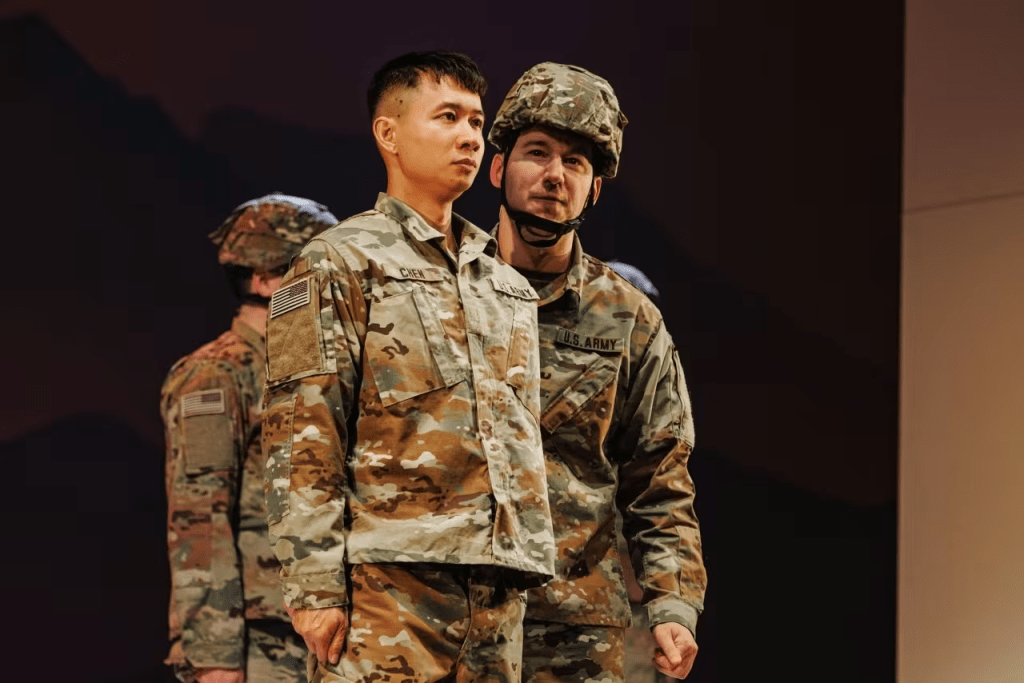
Brian Vu and Alex DeSocio in ‘An American Soldier.’
PHOTO: MARC J. FRANKLIN
New York
Symbols abounded around the New York premiere of Huang Ruo’s opera “An American Soldier” (2018) on Sunday. Its venue, the recently opened Perelman Performing Arts Center, is just blocks from Chinatown, the home of Pvt. Danny Chen, the opera’s real-life protagonist, who took his own life in 2011 after enduring brutal racist hazing in the U.S. Army. Boxy and forbidding, PAC NYC sits across the street from the yawning pits of the 9/11 memorial and catty-corner to the exuberant wings of the Oculus—an impersonal, manufactured crossroads born out of an act of war. Finally, the premiere took place on Mother’s Day, and it is Pvt. Chen’s grieving mother who has this powerful opera’s last word.
Mr. Huang and librettist David Henry Hwang reworked the piece for PAC NYC’s small Zuccotti theater, replacing the large chorus heard in its world premiere at Opera Theatre of Saint Louis with an ensemble of six singers who perform all 18 nonprincipal roles. There is no pit, so the 37-member orchestra was positioned behind the rear scrim, necessitating amplification (David Bullard did the sound design). From a seat in the fourth row, one could hear some natural sound; from the back of the house, the amplification mixing flattened Mr. Huang’s rich orchestral palette and explosive vocal writing.
Still, Chay Yew’s taut, theatrical staging captured the opera’s cruelty and anguish. The well-structured libretto is built around the military trial of Sgt. Aaron Marcum, accused of driving Danny to his death; the story glides seamlessly back and forth from courtroom testimony to flashbacks of Danny’s life before and during his Army service. Danny enlists right out of high school; uninterested in the academically high-achieving, model-minority future expected of Asian teenagers, he longs to find his “team” in the Army. The opera ruthlessly tracks the swift dismantling of that dream. A cheerful, resilient recruit, he takes ethnic slurs in stride during basic training. But once deployed to Afghanistan, he is singled out by Marcum for verbal and physical abuse that intensifies over the course of the second act. In one chilling episode, he is ordered to instruct his platoon—in Chinese—to erect a tent. Just as much as the physical abuse—later, Marcum makes the other soldiers pelt Danny with stones—it makes him believe himself forever an outsider, and kills his hopes.
Hannah Cho and Nina Yoshida Nelsen
PHOTO: MARC J. FRANKLIN Daniel Ostling’s set is an empty, white-sided box; a kitchen table appears for scenes in the Chinatown apartment. Nicholas Hussong’s simple projections on the rear wall suggest locations—the pine trees of the training camp, the mountains of Kandahar; Jeanette Yew’s lighting intensifies the opera’s emotional states, such as cold white bleakness for the courtroom where Danny’s ghost cannot make himself heard and saturated purple for his misery in Afghanistan. A yellow moon accompanies the poignant duet in which Danny and his high-school friend Josephine speak to each other from opposite sides of the world; it expands to fill the entire wall during Mother Chen’s final lullaby. Clean, geometric directing zeroes in on the figures populating the space, whether it’s a line of running soldiers in fatigues (Linda Cho did the costumes) or the intense emotion of a soloist alone onstage.
Tenor Brian Vu was a gripping Danny, seizing on the young man’s determination to be himself, whatever the cost. Nina Yoshida Nelsen’s eloquent mezzo brought out Mother Chen’s toughness, battling the military to get justice for her son. Soprano Hannah Cho relished Josephine’s high-flying vocal lines and exuded warmth in the scenes where she reads Danny’s letters to his mother; Alex DeSocio was appropriately vicious as Marcum.
The six fine ensemble members—Christian Simmons, Ben Brady, Joshua Sanders, James C. Harris, Shelén Hughes and Cierra Byrd—shifted roles with aplomb. Mr. Simmons, with his resonant bass-baritone, stood out as the Military Judge and Pvt. Manny Davis, who testifies about his own experience of Marcum’s racist behavior. Conductor Carolyn Kuan skillfully paced the American Composers Orchestra, winding up the opera’s tension and managing its brief intervals of release. Amplification challenges notwithstanding, we heard—and felt—the military fanfares and ostinatos that limn the anxious progress of Danny’s story and the haunting digeridoo that accompanies his restless ghost.
_______________
Opera Lafayette, a Washington-based company specializing in historical performance, had a winner with Jean-Joseph Mouret’s “Les Fêtes de Thalie” at New York’s El Museo del Barrio on May 7. Hugely popular for decades after its 1714 premiere, this opera-ballet sets out to demonstrate that, in the words of its titular muse of comedy, “One tires quickly of weeping. Does anyone ever tire of laughing?” Muses and gods squabble in the prologue and epilogue that bracket three gossamer-light stories about love. Opera Lafayette’s witty production, directed by Catherine Turocy, with its skillful integration of dance, kept the emphasis on fun, as did the splendid conductor, Christophe Rousset, and the small but snappy period-instrument orchestra; the elegant performing edition was created by harpsichordist Korneel Bernolet.
The game cast of nine singers and eight dancers took multiple roles. Some notable performances included soprano Angel Azzarra aptly over-emoting as the muse of tragedy in the prologue; tenor Scott Brunscheen and baritone John Taylor Ward vying for the hand of a widow in the second vignette, “La Veuve Coquette” (she opts to remain single); and soprano Pascale Beaudin in the roles of the widow, a scorned wife in the third vignette, “La Femme,” and Terpsichore, muse of dance, in the epilogue. Marie Anne Chiment’s gleeful era-mixing costumes helped set the tone. Similarly, each vignette had its own choreographer and style, the most delightful and surprising of which was the Indian wedding staged as an entertainment in the middle of “La Veuve Coquette.” Choreographed by Anuradha Nehru and Pragnya Thamire in Kuchipudi, a classic Indian style, its elegant shapes and sprightly rhythms fit the 18th-century music perfectly.
Ms. Waleson writes on opera for the Journal and is the author of “Mad Scenes and Exit Arias: The Death of the New York City Opera and the Future of Opera in America” (Metropolitan).
John Adams’s oratorio, which draws on a diverse set of texts to tell the biblical story, receives a joyful production at the Metropolitan Opera; at NYU’s Skirball Center, Catapult Opera presented the U.S. premiere of a work by the eminent 20th-century composition teacher Nadia Boulanger.
By
Heidi Waleson
April 25, 2024 at 7:00 pm ET
Julia Bullock (center) and Siman Chung, Key’mon W. Murrah, and Eric Jurenas (above) in ‘El Niño.’
PHOTO: EVAN ZIMMERMAN / MET OPERA
New York
The Metropolitan Opera’s first production of John Adams’s dynamic oratorio “El Niño” (2000) on Tuesday radiated joy. An unconventional recounting of the Nativity, the work has dark moments; yet its overall message is one of hope, stemming from the ongoing miracle of birth. Taking her cue from the Latin American poetry in the libretto, director Lileana Blain-Cruz, along with set designer Adam Rigg and projection designer Hannah Wasileski, devised an environment filled with bright color and pulsating movement; the set’s flat surfaces and the whimsical flying effects and puppetry gave it the feeling of a child’s pop-up book come to brilliant life.
As the production makes clear, the piece works as a theatrical narrative centered on a woman’s experience of pregnancy, birth and motherhood—both mundane and miraculous—in an uncertain world. The libretto, arranged by Mr. Adams and Peter Sellars (who also directed the world premiere in Paris), intersperses familiar Gospel accounts with poems by three Latin American women—Rosario Castellanos, Gabriela Mistral and Sor Juana Inés de la Cruz—along with other poems, stories from the New Testament Apocrypha, Old Testament prophecies, and texts drawn from Martin Luther, Hildegard von Bingen and the Wakefield Mystery Plays. The story takes us from the Annunciation through the birth of Jesus in Part I; the adoration of the shepherds, the slaughter of the innocents, and the flight into Egypt make up Part II. Scenes of domestic intimacy alternate with explosive choral and orchestral statements; Mr. Adams’s arresting score seldom flags.
J’Nai Bridges and Ms. Bullock (center) and company.
PHOTO: EVAN ZIMMERMAN / MET OPERA
Two Marys make the journey. Soprano Julia Bullock, vividly intense in her Met debut, and mezzo J’Nai Bridges, her lusher sound offering a moodier, more internal aspect of the Virgin, came together eloquently in their duet “Se habla de Gabriel,” a Castellanos poem about the physical and psychic pain of pregnancy and birth. Ms. Bullock’s radiant, anticipatory “Magnificat” in Part I was balanced in Part II by her wails and leaping intervals in the devastating “Memorial de Tlatelolco,” also by Castellanos, a mother’s bitter mourning of the 1968 massacre of student protesters by the Mexican military, a modern-day slaughter of the innocents. Ms. Bridges did her best with the score’s one miscalculation, an overlong setting of Castellanos’s “La Anunciación”; she was heard to greater advantage in the lullaby with chorus that begins Part II.
The powerful baritone Davóne Tines, also making his Met debut, supplied male ferocity—he was God in “Shake the Heavens” (a nod to “Messiah,” a clear “El Niño” forebear, which used the same text from the Book of Haggai for a bass recitative) and a raging, venomous Herod, demanding that the Magi find the child and report back. In contrast, one of his finest moments was the simple song of the gently enraptured Joseph, who, just before the birth, sees everything on earth suddenly stand still. Three countertenors—Key’mon W. Murrah, Siman Chung and Eric Jurenas—blended ethereally to depict Gabriel, the three Magi and the piece’s narrator. The Met chorus, though at times uncomfortable with the choreographed movement, was impressive in noisy scenes like “In the day of great slaughter.” Conductor Marin Alsop, in her Met debut, skillfully paced the show, whether letting the orchestra erupt in violent minimalist oscillations or whittling it down to a single guitar.
Davóne Tines
PHOTO: EVAN ZIMMERMAN / MET OPERA
Ms. Blain-Cruz’s direction made the work’s big moments stand out. In the opening scene—a vibrant countryside of greens and blues, with a trio of lavishly dressed Latin American Virgin figures in the background and a stage crammed with people—the three countertenors, in glittering silver robes and crowns (the costume designer was Montana Levi Blanco), ascended into the air for Gabriel’s “Hail, Mary Gracious!” In “Shake the Heavens,” Mr. Tines was flanked by seven enormous pink and purple insect wings, each with a glowing eye. Birth takes center stage in the tumultuous Part I finale of “El Niño”: The chorus and soloists sing Mistral’s “The Christmas Star,” a riveting depiction of a girl holding a star and burning up, interspersed with Hildegard von Bingen’s ecstatic “O Quam Preciosa.” Here, amid the joyful noise, a shining cutout of the running girl passed across the background, both Marys were in labor—Ms. Bridges in a boat high above the stage—and shooting stars blazed through the sky.
Intimate scenes were similarly well-conceived: Elisabeth, whose “babe leaped in her womb” upon meeting Mary, was played by a dancer, with five other dancers shadowing her, bending backward in ecstasy (Marjani Forté-Saunders created the athletic, eye-filling choreography). Ms. Bullock sang the “Memorial” aria on a darkened stage (Yi Zhao did the lighting), surrounded by slaughtered children; they stood up, bathed in purple light, for the final stanzas about remembrance as eyes appeared, embedded in stylized ocean waves, on the backdrop video. In Part II, desert cacti replaced the greenery; dancers became a community of migrants accompanying the Holy Family on their flight, and pausing around a campfire to contemplate the natural elements—in the words of Sor Juana—that will help them. Dragons tamed by the child Jesus were whimsical puppets. And for the final song, a simple children’s chorus in praise of the palm tree that succored the travelers in the desert, the children stood in a line at the front of the stage, ending the piece as quietly as the opening had been ebullient—two sides of joy.
* * *
“La ville morte,” the only opera by Nadia Boulanger, the renowned composition teacher of Aaron Copland, among many others, was given its U.S. premiere by Catapult Opera last weekend at NYU’s Skirball Center. Written with her mentor Raoul Pugno and finished in 1913, the work was sidelined by World War I; a reconstructed version was finally performed in Sienna, Italy, in 2005. Catapult commissioned a new 11-instrument accompaniment to replace Boulanger’s lost orchestration.
In Gabriele D’Annunzio’s overheated libretto, Alexandre and Anne, a married couple, and Léonard, an archaeologist, are all in love with Léonard’s sister, Hébé. The text and the music are reminiscent of Debussy’s “Pelléas et Mélisande,” but without the mystery: Alexandre woos Hébé aggressively while Léonard’s declaration is filled with self-loathing. Hébé’s feelings in the matter appear to be less important, though her duets with Anne have an erotic undercurrent. Naturally, she has to die in the end.
Lushness was needed to put this across, but Catapult’s production was undernourished. Melissa Harvey’s light soprano needed more juice for Hébé’s Straussian death aria; as Léonard, Joshua Dennis’s tenor sounded strangled at high intensity. Baritone Jorell Williams and mezzo Laurie Rubin were capable rather than compelling, and the orchestra, led by Neal Goren, only hinted at color. The chorus was eliminated. Robin Guarino’s abstract staging and Andromache Chalfant’s set placed much of the action in a tiny, white, box-like room surrounded in darkness, an oddly chilly environment for all this feverishness.
Ms. Waleson writes on opera for the Journal and is the author of “Mad Scenes and Exit Arias: The Death of the New York City Opera and the Future of Opera in America” (Metropolitan).
The company, celebrating its 10th anniversary season, offers a contemporary spin on Tchaikovsky’s ‘Eugene Onegin’ and the world premiere of Dan Schlosberg’s eco-themed ‘The Extinctionist.’
By Heidi Waleson
April 8, 2024 at 5:04 pm ET
The company of ‘Eugene Onegin’ in the Heartbeat Opera production.
PHOTO: RUSS ROWLAND
New York
Heartbeat Opera, now presenting its 10th anniversary season at the Baruch Performing Arts Center, specializes in putting a contemporary spin on classic operas through musical and theatrical adaptation. Its take on Tchaikovsky’s “Eugene Onegin” by Dustin Wills and Jacob Ashworth (Heartbeat’s artistic director) posits that Onegin’s secret love for his friend Lensky is the reason that he coldly rejects Tatyana’s amorous declaration and then goads Lensky into a fatal duel. But—as was the case with last season’s “Lady M,” Heartbeat’s version of Verdi’s “Macbeth”—the idea doesn’t quite cohere. Directed by Mr. Wills, the show bluntly shoehorns the concept into the score, which has been trimmed to 100 minutes and radically rearranged by Dan Schlosberg(Heartbeat’s music director) for nine musicians.
The conceit is love as performance and artifice. The set, designed by Mr. Wills, is a collection of frames, platforms, ladders, footlights and other backstage gear, handily assembled into different locations with the aid of the performers; costume designers Haydee Zelideth and Asa Benally mix contemporary outfits with dress-up clothes—an epauletted military jacket, a clown suit. When Olga and Lensky sing their first arias, they grab microphones and spotlights, suggesting that their emotions are as much performative as heartfelt. Prince Gremin, Tatyana’s adoring husband in the third act, is an automaton—his batteries run down at the conclusion of his aria, and he’s carted offstage on a dolly. Reza Behjat’s lighting emphasizes the switches from acting to—maybe—reality.
The gay subtext is subtle—perhaps too much so. Onegin and Lensky exchange some meaningful glances. During their confrontation at Tatyana’s name-day party—ostensibly over Onegin’s flirtation with Olga—Onegin gropes Lensky; they kiss for the first and only time just before the duel. But the actual opera gets in the way. Why would Onegin pursue Tatyana at the end? Do we interpret his explosion of passion for her as performance (the scene is played on a miniature stage, with the other characters as the applauding audience) or, perhaps, displacement? It’s not clear.
As for the other snag, this was Tatyana’s show. With her luminous soprano, Emily Margevich captured the young girl’s romantic abandon in the Letter aria, and the adult woman’s sense of loss in the final scene. As Onegin, Edwin Joseph’s colorless baritone was no match for her or for Roy Hage’s poignant Lensky, whose pre-duel farewell aria—to Olga and life—was eloquently sung. The adaptation also cut Onegin’s aria at the beginning of Act 3, making him seem even less consequential.
Mezzo Sishel Claverie displayed considerable personality as Olga; she donned the clown outfit and sang Monsieur Trinquet’s name-day salute to Tatyana, starting at tenor pitch and then wandering through different keys along with orchestration, like a slowed-down recording. Shannon Delijani (Madame Larina), Tynan Davis (Filipyevna) and Lloyd Reshard Jr. (Prince Gremin) ably sang chorus parts in addition to their own. Mr. Ashworth energetically led the ensemble from the violin. Mr. Schlosberg’s arrangement had some interesting elements, such as the harp filling in textures, and saxophone (one player tripled with clarinet and bass clarinet) that turned the Act 3 ball into a raucous, Kurt Weill-style cabaret. But the scrappy string playing and the electronic effects on the second violin, electric guitar and electric bass often left the music sounding muddy and chaotic, overdoing the swerve away from romance and into nightmare.
Eliam Ramos and Katherine Henly in ‘The Extinctionist.’
PHOTO: RUSS ROWLAND
Heartbeat’s first world premiere, “The Extinctionist” with music by Mr. Schlosberg and a libretto by Amanda Quaid (who wrote the play on which it is based), is contemporary from the start: Its protagonist, called only Woman (Katherine Henly), is agonizing about having a baby in a world being destroyed through human-accelerated climate change. “Every child born today is making it worse,” she tells her pregnant Friend (Claire Leyden). In a tight 75 minutes, the opera deftly seesaws between extremes—Woman’s longing for motherhood and her terror about the future. Man, her husband (Philip Stoddard), and her doctor (Eliam Ramos) keep suggesting that she will change her mind about her wish for sterilization; it’s left to us to decide if theirs is a reasonable response, a patriarchal reaction to “female hysteria,” or the obtuse dismissal of a modern Cassandra.
Mr. Schlosberg’s score reflects the centrality of Woman’s anguish: Her high-flying, jittery vocal line seems to brush off the vocal efforts of the other characters. The sound of the four-member ensemble (violin/viola, electric guitar, and percussion, led by Mr. Schlosberg from the piano) ranges from delicate transparency to electronic roar; it keeps returning to a two-note motif that evokes—depending on the moment—a heartbeat, a dripping tap, or the inexorable ticking of a clock. Two solo interludes—one for electric guitar, the other for drums—emphasize the ominous atmosphere.
Kate Noll’s spare set, with a bedroom on one side of the stage, a chair and table on the other, and some bare trees in front, incorporated the band as part of the show. Camilla Tassi’s projections suggested locations including a doctor’s office and a fancy shopping mall, along with the cataclysms of fire and flood. Shadi Ghaheri’s sensitive direction made clever use of a puppet for Woman’s dream about her imagined child and even managed the awkwardness of an onstage gynecological examination. Ms. Henly threw herself fully into Woman’s vocal and emotional turmoil. With Woman left alone at the end and her decision made for her, her haunting contemplation of a future in which “the sidewalks will be rivers again” captured the opera’s sorrowful ambivalence in the face of an impossible choice.
Ms. Waleson writes on opera for the Journal and is the author of “Mad Scenes and Exit Arias: The Death of the New York City Opera and the Future of Opera in America” (Metropolitan).