
Countertenor Anthony Roth Costanzo sings all the opera’s major parts in a brilliant, frenetic production on the Hudson River.
By
Heidi Waleson
Sept. 9, 2024 at 5:42 pm ET
Anthony Roth Costanzo
PHOTO: NINA WESTERVELT
New York
“The Marriage of Figaro” is the ultimate ensemble opera, so what happens when one person sings all the parts? The countertenor Anthony Roth Costanzo is currently doing just that at Little Island’s outdoor amphitheater in a brilliantly demented 100-minute adaptation whose sheer bravado coupled with musical and theatrical inventiveness make it much more than a stunt. With its frenetic, accelerating energy and constant switching of focus, this “Figaro” exemplifies the opera’s revolutionary, topsy-turvy roots—the servants get the upper hand over the aristocracy—expressed through high comedy.
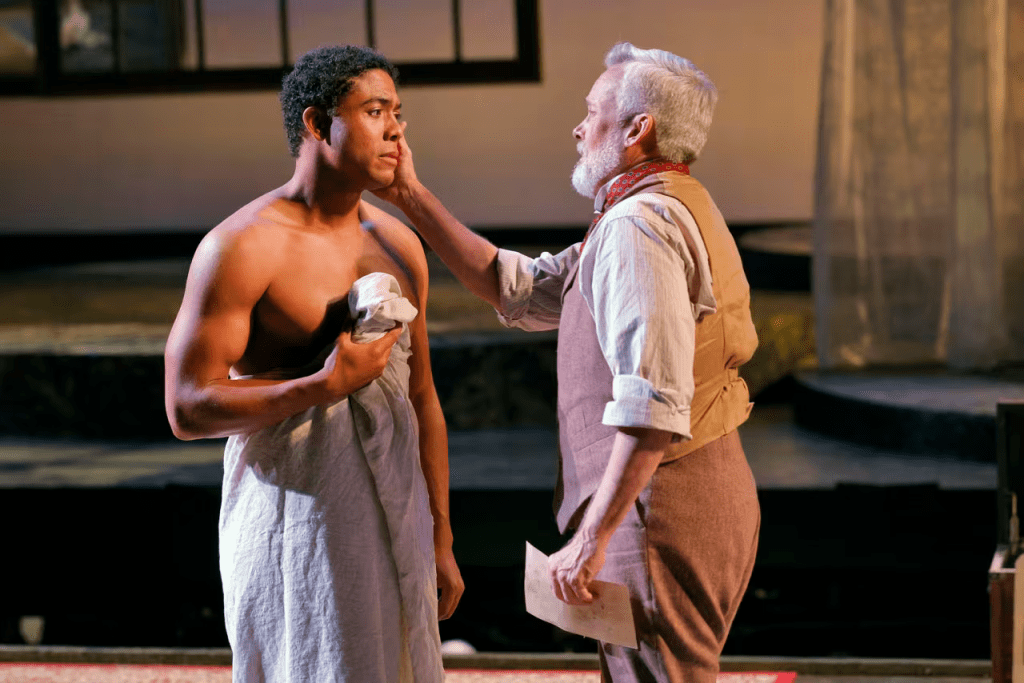
The mayhem starts right away. With the help of a door in a movable frame, a tricorn hat, and a dress, Mr. Costanzo sings and acts both parts in the brisk duet “Se a caso madama,” switching between Figaro (bass-baritone) and Susanna (soprano) as they debate the Count’s motives in giving them such a convenient bedroom. Each succeeding scene raises the stakes. Five excellent actors play Figaro, Susanna, the Count, the Countess, Basilio and Antonio, lipsynching to Mr. Costanzo’s voice; Mr. Costanzo plays Cherubino whenever he is in the scene.
Ariana Venturi, Mr. Costanzo, Ryan Shinji Murray, Emma Ramos and Daniel Liu. PHOTO: NINA WESTERVELT
In the arias, you sometimes forget that the lipsynching is happening, even though Mr. Costanzo is always part of the action and executing feats of physical comedy; in the ensembles, his leaps among the vocal ranges of the characters can make a spectator feel breathless. For the frenzied Act 2 finale, he dove through six different lines, singing segments from each, and then broke out a foot-operated live looper pedal that layered them together. After his two last notes—a three-octave jump—he collapsed and was carried off on a gurney. And that was just halfway through the show.
Mr. Costanzo is surprisingly convincing in the voices of these characters—they sound different, whether it’s Figaro’s hearty “Non più andrai” or Susanna’s radiant “Deh vieni, non tardar.” The amplification helps, and eight of the 20 numbers are transposed from their original keys, though closely enough that you don’t notice. Dan Schlosberg’s typically ingenious orchestral arrangement—for keyboard, four strings, horn, and two clarinets doubling bass clarinet, saxophone and recorder—supplies its own witty commentary; he leads from the keyboard. Additional musical contributions come from seven boys from the Young People’s Chorus of New York City singing the Act 3 chorus of village maidens presenting flowers to the Countess as well as Barbarina’s plaintive search for the lost pin.
Dustin Wills’s direction makes it all work, preserving the transgressive spirit of the opera through all the cuts, musical manipulations and speedy comic pacing. A female actor (Ariana Venturi) plays the Count; a male (Daniel Liu) is the Countess; Ryan Shinji Murray, a circus artist, does flips on a trampoline as the drunken gardener Antonio. The circus/vaudeville/drag references are reinforced by quick-change set pieces (by Lisa Laratta and Mr. Wills), Mr. Costanzo’s red, clown-like Cherubino outfit by costume designer Bode, and Barbara Samuels’s lighting.
Mr. Costanzo
PHOTO: NINA WESTERVELT
Mr. Costanzo gets a brief rest after his simulated collapse. The actors get mike headsets and vamp: Mr. Liu supplies a synopsis of what’s happened so far; he (as the Countess) and Emma Ramos (as Susanna) do a scene in French from the Beaumarchais play; Figaro (Christopher Bannow) delivers a furious soliloquy—in English, adapted from Beaumarchais—about his frustrations. The choice to have Mr. Costanzo, in a hospital gown and hooked up to an IV, appear to undergo a laryngoscopy (the images were pre-recorded) while he sings the Countess’s mournful “Dove sono” was perhaps over the top, but how many audience members have seen vocal chords in operation? It made the point—those two little structures are responsible for so much, and while the collapse was staged, Mr. Costanzo is taking a risk with his instrument. He is singing 18 performances of “Figaro” over three weeks.
Mr. Costanzo is no stranger to risk. In June, he became the general director and president of Opera Philadelphia. The company was in serious financial trouble, its 2024-25 season pared back and its trailblazing fall festival eliminated. Mr. Costanzo was able to raise $7 million to cover the debt and the first show—Missy Mazzoli’s “The Listeners,” opening Sept. 25. He also reasoned that since ticket revenue represents a small fraction of the operating budget of most opera companies (it was estimated at 8% for OP’s new season), why not cut prices and get people into the theater? With “Pick Your Price,” announced on Aug. 27, any seat for the season—a total of nine performances of three operas at the Academy of Music—could be purchased for as little as $11. Within days, most of the tickets were sold, many to buyers who had never bought an Opera Philadelphia ticket before. As of Sept. 6, the few seats remaining were all in the topmost tier, and OP was considering offering partial-view places for sale.
Mr. Costanzo is betting that the revenue lost from tickets will be made up through donations. He also calculates that if he doesn’t have to program to please the conservative patrons who purchase the most expensive tickets, he can cast a wider artistic net. His inventiveness, collaborative skills, and powers of persuasion, all on full display at Little Island—where the tickets, priced at $25, also sold out within days—will be challenged in another arena that holds the possibility of collapse, this time for real.
Ms. Waleson reviews opera for the Journal and is the author of “Mad Scenes and Exit Arias: The Death of the New York City Opera and the Future of Opera in America” (Metropolitan).
 AndyManshel.nyc